The Philosopher
Zeno of Elea
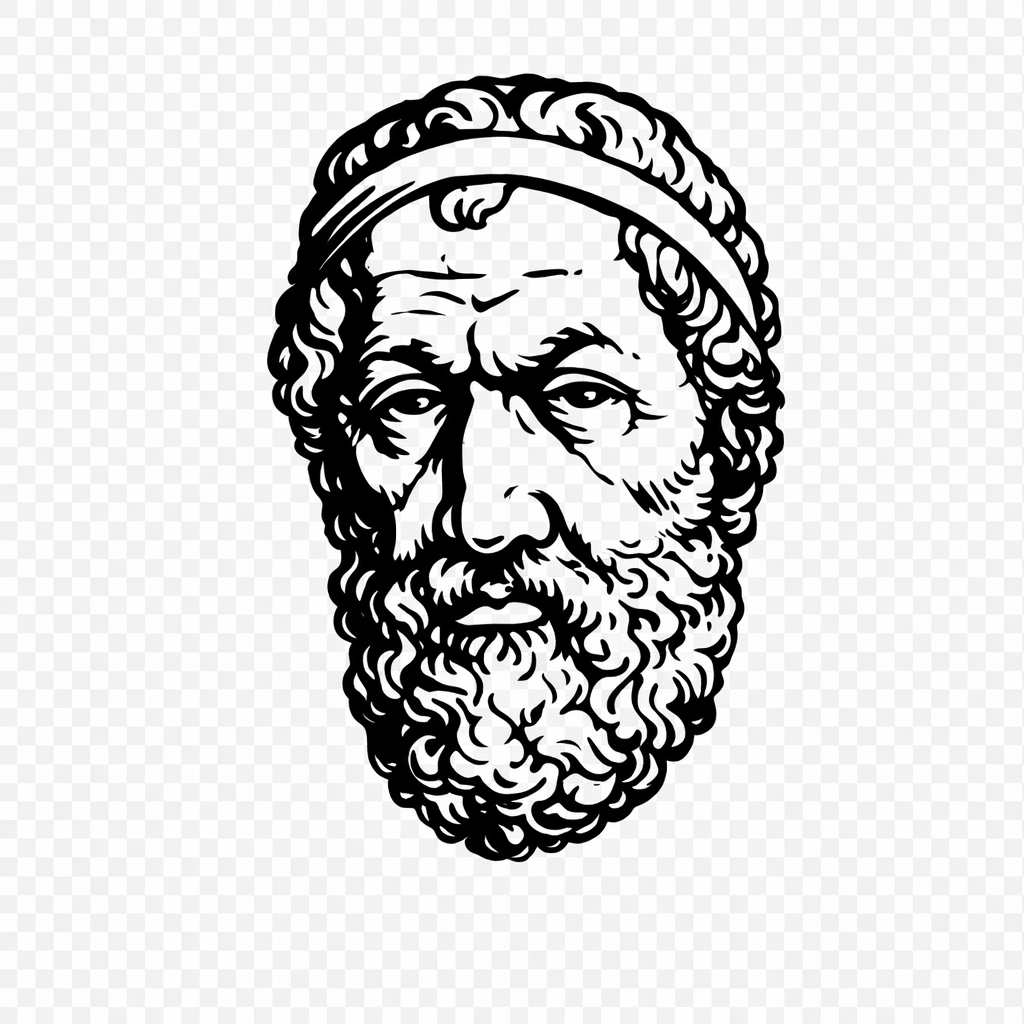
The face
The background
- Nationality:
- Greek
- Schools:
- Eleatic
- Branchs:
- Metaphysics, Ontology
- Period:
- Pre-Socratic philosophy
The synopsis
Zeno of Elea was a pre-Socratic Greek philosopher from Elea in Southern Italy (Magna Graecia). He was a student of Parmenides and a member of the Eleatic school, which advocated for monism, the belief that reality is fundamentally one. Zeno is most famous for his series of paradoxes, designed to challenge the commonly held notions of space, time, and motion, thereby supporting Parmenides's view of a static, unchanging reality. Though his original writings are lost, his arguments are preserved through the works of later philosophers such as Plato, Aristotle, Diogenes Laertius, and Simplicius of Cilicia.
Zeno's arguments are typically categorized into those against plurality and those against motion. His arguments against plurality suggested that the existence of multiple objects would lead to contradictions, such as an object simultaneously having infinite mass and no mass. His paradoxes concerning motion, including the Dichotomy, Achilles and the Tortoise, and the Flying Arrow, aimed to show that motion is illusory by demonstrating that an infinite number of steps or divisions would be required to traverse any distance or time. These paradoxes have profoundly influenced logic, mathematics, and physics, and continue to be subjects of study and debate. Modern interpretations and solutions often involve concepts from calculus, set theory, and quantum mechanics, though no single resolution is universally accepted.
The works