The Philosopher
Xenophanes
The face
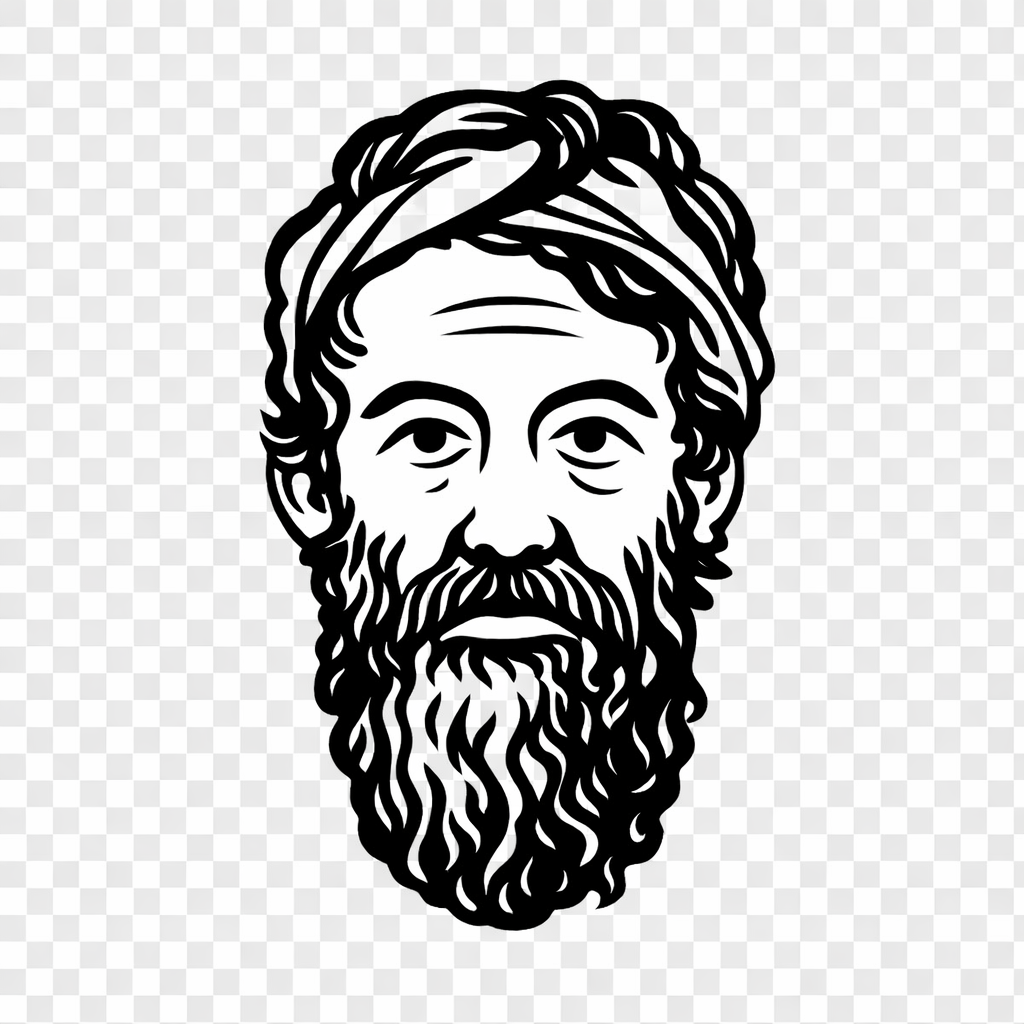
The background
- Nationality:
- Greek
- Schools:
- Eleatic school, Pyrrhonism
- Branchs:
- Social Criticism, Natural Philosophy, Epistemology, Theology
- Period:
- Pre-Socratic philosophy
The synopsis
Xenophanes of Colophon, a Greek philosopher, theologian, poet, and critic of Homer, lived from approximately 570 to 478 BC. Born in Ionia, he spent much of his life as an itinerant poet, travelling throughout the Greek-speaking world. His poetry, often critical and satirical, challenged the prevailing social and religious norms of his time. He famously critiqued the anthropomorphic representations of gods in the works of Homer and Hesiod, proposing a more abstract and unified conception of divinity. Xenophanes is considered a key figure among the pre-Socratic philosophers for his attempts to provide naturalistic explanations for phenomena like clouds and rainbows, moving away from purely mythological accounts. He also made significant contributions to epistemology, distinguishing between true belief and knowledge and suggesting that certainty was the domain of the gods. His influence extended to later philosophical schools like the Eleatics and the Pyrrhonists, though modern scholarship views him as a highly original thinker in his own right.
The works
Satires
On Nature
The quotes
If cattle and horses, or lions, had hands, or were able to draw with their feet and produce the works which men do, horses would draw the forms of gods like horses, and cattle like cattle, and they would make the gods' bodies the same shape as their own.
No human being will ever know the Truth, for even if they happen to say it by chance, they would not even known they had done so.
All men begin their learning with Homer.
Better than the strength of men and horses is our wisdom.
Men create the gods in their own image.
It takes a wise man to recognize a wise man.
But if cattle and horses or lions had hands, or were able to draw with their hands and do the work that men can do, horses would draw the forms of the gods like horses, and cattle like cattle, and they would make their bodies such as they each had themselves.
It isn't right to judge strength as better than good wisdom.
There is one God - supreme among gods and men - who is like mortals in neither body nor mind.
The gods did not reveal, from the beginning, all things to us.