The Philosopher
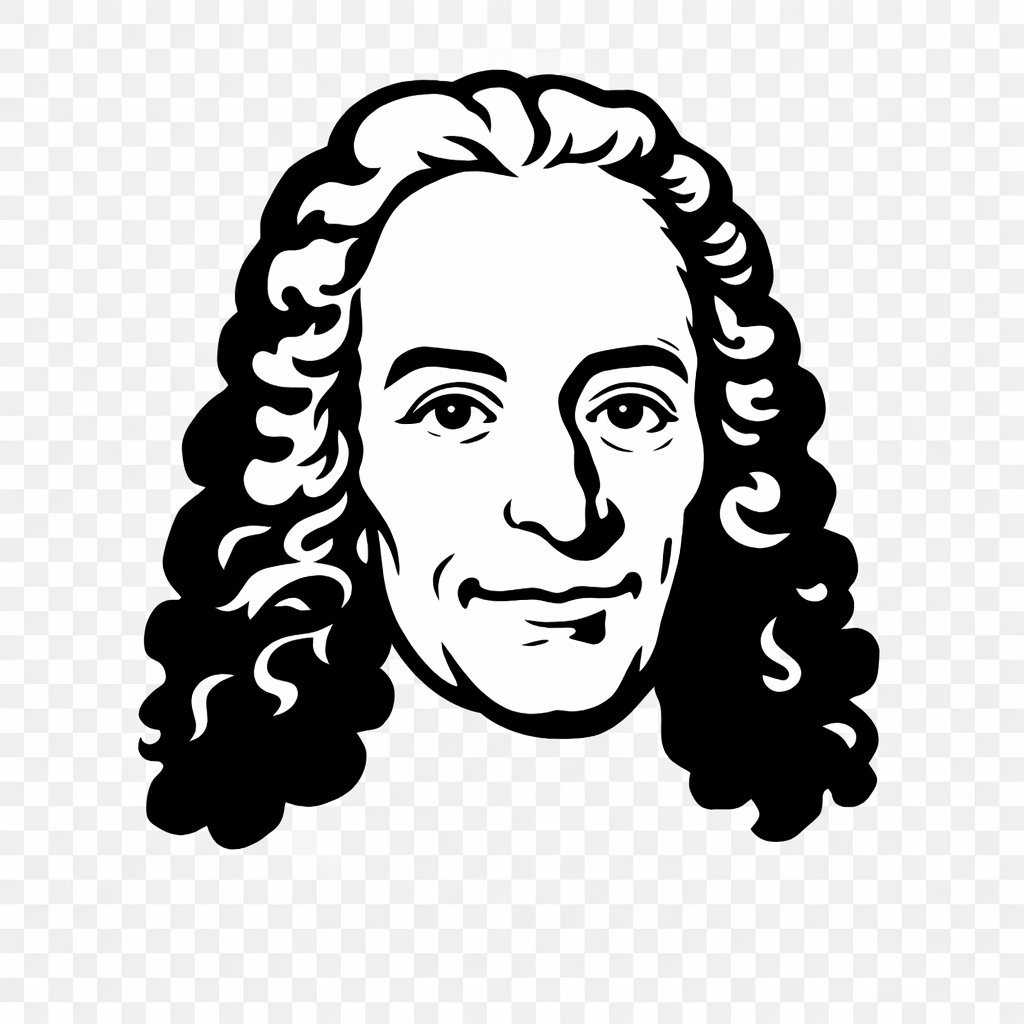
Voltaire
The face
The background
- Nationality:
- French
- Schools:
- Lumières, Philosophes, Deism, Classical liberalism
- Period:
- Age of Enlightenment
The synopsis
François-Marie Arouet, known as Voltaire, was a prominent French Enlightenment writer, philosopher, satirist, and historian, born in Paris in 1694 and dying in 1778. He was a fierce advocate for civil liberties, including freedom of speech and religion, and famously criticized organized religion, particularly the Catholic Church, as well as the institution of slavery. Voltaire's prolific output spanned almost every literary genre, including plays, poems, novels, essays, histories, and scientific expositions. He authored over 20,000 letters and more than 2,000 books and pamphlets, achieving international renown and commercial success. His most famous work, the novella *Candide*, satirizes optimistic philosophy and criticizes many aspects of his contemporary society. Voltaire's early life was marked by conflict with authorities, leading to imprisonment and exile, notably to England, where he was influenced by its constitutional monarchy and greater freedoms. His residence in England and subsequent writings, like *Letters Concerning the English Nation*, brought him into conflict with French authorities, forcing him to flee multiple times. He had a significant intellectual relationship with Émilie du Châtelet, a mathematician, with whom he studied and experimented at her château in Cirey. Later in life, he lived in Prussia at the invitation of Frederick the Great, though this relationship soured. He eventually settled in Ferney, near Geneva, where he continued his prolific writing and became a champion for the unjustly persecuted. Voltaire's remains were eventually enshrined in the Panthéon in Paris, recognizing his influence as a precursor to the French Revolution.
The works
Candide
The Maid of Orleans
The Age of Louis XIV
Letters on the English
Dictionnaire philosophique
History of Charles XII
Treatise on Tolerance
Micromégas
Zadig