The Philosopher
Rudolf Steiner
The face
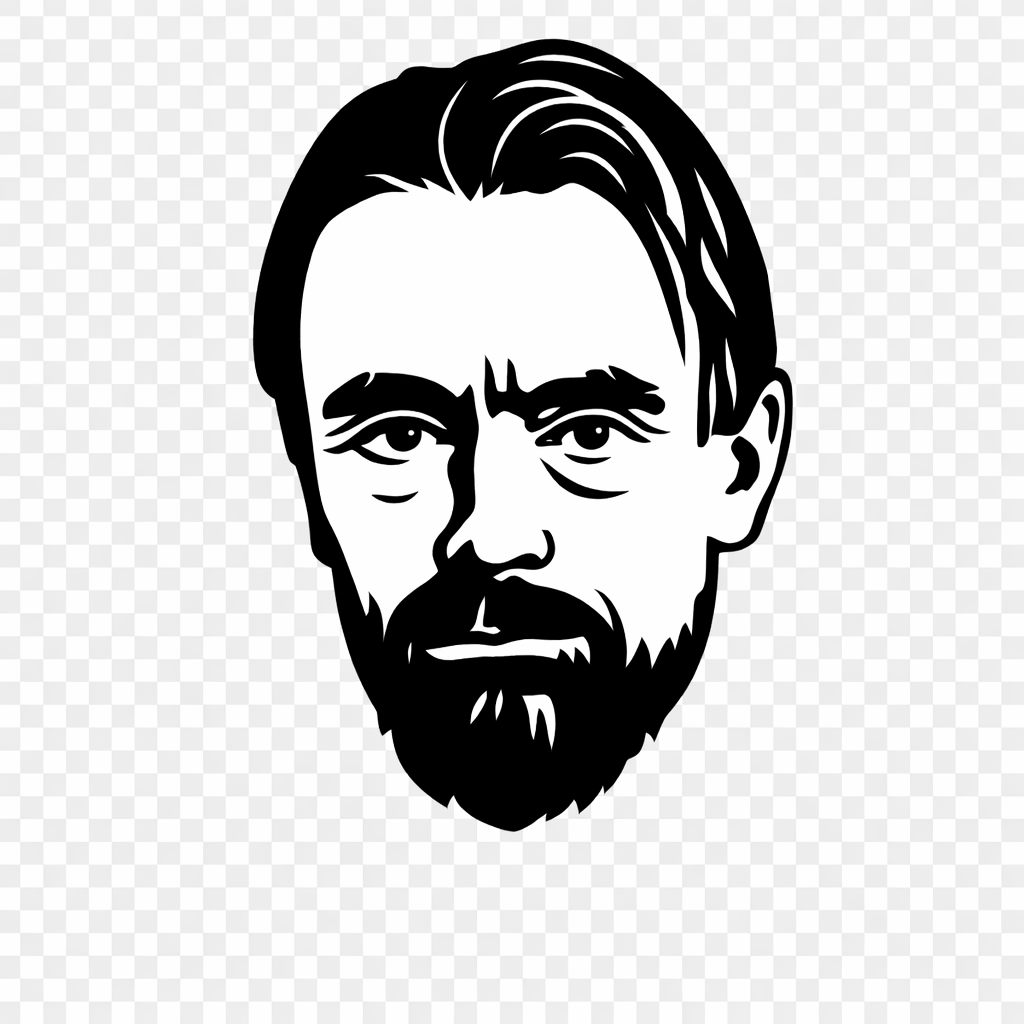
The background
- Nationality:
- Austrian
- Branchs:
- Anthroposophy, Theosophy, German Idealist Philosophy, Gnosticism
- Period:
- 19th and 20th centuries
The synopsis
Rudolf Steiner (1861–1925) was an Austrian esotericist, philosopher, occultist, social reformer, architect, and clairvoyant. He gained recognition as a literary critic before founding the esoteric spiritual movement of anthroposophy, which draws from German idealism and theosophy. Steiner sought to combine scientific clarity with spiritual inquiry, developing "spiritual science" as a means to understand the spiritual world. He also engaged in artistic endeavors, culminating in the construction of the Goetheanum. Post-World War I, he applied his ideas to practical projects like Waldorf education, biodynamic agriculture, and anthroposophical medicine. His epistemology was influenced by Goethe, viewing thinking as a perceptual organ. Steiner advocated for ethical individualism and a belief in the limits of human knowledge.
The works
The Philosophy of Freedom
The Theory of Knowledge Implicit in Goethe's World-Conception
Goethe's Conception of the World
Theosophy: An Introduction to the Spiritual Processes in Human Life and in the Cosmos
How to Know Higher Worlds: A Modern Path of Initiation
Cosmic Memory: Prehistory of Earth and Man
The Education of the Child
An Outline of Esoteric Science
Four Mystery Dramas
The Renewal of the Social Organism
Fundamentals of Therapy: An Extension of the Art of Healing Through Spiritual Knowledge
Reincarnation and Immortality
Rudolf Steiner: An Autobiography
Friedrich Nietzsche, Fighter for Freedom
The quotes
A healthy social life is found only when, in the mirror of each soul, the whole community finds its reflection, and when, in the whole community, the virtue of each one is living.
Observation and thinking are the two points of departure for all the spiritual striving of man, insofar as he is conscious of such striving. The workings of common sense, as well as the most complicated scientific researches, rest on these two fundamental pillars of our spirit.
The Oriental thinks everything in the sense-perceptible world is 'maya'; everything perceived by our senses and all thinking connected with sense perceptions is 'maya,' the great illusion. The only reality is the reality of the soul. What a human being achieves in his or her soul is reality.
Between death and a new birth, we know that our body, down to its smallest particles, is formed out of the cosmos. For we ourselves prepare this physical body, bringing together in it the whole of animal nature; we ourselves build it.
We must guard against disrespectful, disparaging, and criticizing thoughts. We must try to practice reverence and devotion in our thinking at all times.
If you observe children with sufficient objectivity as they grow into the world, then you will perceive that children's temporal bodies are still not fully connected with the spirit-soul. The task of education, understood in a spiritual sense, is to bring the soul-spirit into harmony with the temporal body.
You must take a definite idea, set it in the centre of your thinking, and then logically arrange your furthest thoughts in such a way that they are all closely linked with the original idea. Even if you do this for only a minute, it can be of great importance for the rhythm of the physical and etheric bodies.
You cannot be an educator or a teacher without relating to children with full insight. Their urge to imitate has been transformed into a receptivity based on a natural and uncontested relationship of authority, and you must take this into account in the broadest possible sense.
By immersing ourselves with our consciousness in a supersensible world, we now learn a new kind of thinking, a new life of mental pictures, one that is not dependent on the nervous system in the way ordinary thinking is. We know that previously we have had to make use of our nervous system, but now we no longer need our brain.
Most actions derive not from your own initiative but from your family circumstances, your education, your calling, and so on. You must therefore give up a little time to performing actions which derive from yourself alone. They need not be important; quite insignificant actions fulfill the same purpose.
It should not be expected that what is spiritual can be brought before the eyes, before the senses. It must be experienced inwardly and spiritually.
However superficial prevailing views of heredity seem to be, it must be admitted that a person is indeed the bearer of inherited characteristics. This is the one aspect. He must often battle against these inherited traits and rid himself of them in order to bring to fulfillment the talents laid into him before he entered earthly existence.
We have to realize that when we talk in front of other people about things only we can understand, those people will not be able to avoid getting wrong impressions.
What the human being sees, what is poured into his environment, becomes a force in him. In accordance with it, he forms himself.
Immortality is the negation of death. We do not usually speak about 'innatality' - about having not yet been born - yet this is something we would have to regard as the other aspect of the human soul. We are just as unborn as we are immortal.
I have often called attention to the fact that walking through the streets in the Middle Ages was a different experience from nowadays. Right and left, there were house facades that were built out of what the soul felt and thought. Every key, every lock, carried the imprint of the person who had made it.
However true it may be that we have estranged ourselves from Nature, it is nonetheless true that we feel we are in her and belong to her. It can be only her own working which pulsates also in us. We must find the way back to her again.
We must never forget that higher knowledge has to do with revering truth and insight and not with revering people.
You can go from object to object, from plant to plant, from animal to animal and regard them as symbols for the spiritual. In this way, you make your imaginative capacities fluid and release them from the sharp contours of sense perception.
Gothic architecture requires individual craftsmanship. The wish to create an enclosed world for the congregation gives rise in Gothic architecture to the need to create something wherein the activity of the congregation plays a part.
Just as future eclipses of the Sun and Moon are indicated in the present relations of those bodies, so are future earthly lives indicated in what now lives within us.
The realms of life are many. For each one, special sciences develop. But life itself is a unity, and the more deeply the sciences try to penetrate into their separate realms, the more they withdraw themselves from the vision of the world as a living whole.
When you objectively observe the most spiritual area to which modern people devote themselves, the religions, ask yourself if the basis of modern culture, particularly in religion, is not human self-interest. It is typical of modern sermons that the preacher criticizes people for their selfishness.
Only man is permitted to live without rhythm in order that he can become free. However, he must of his own accord bring rhythm again into the chaos.
Prenatal education can only be an unconscious result of what the parents, particularly the mother, do. If, until the child is born, the mother acts in such a way that she expresses what is morally and intellectually correct, then what she accomplishes in her own continuing education will transfer to the child.
A living art of teaching, one that rests on a true understanding of the human being, has a thread of strength running through it that stimulates individual students to participate so that it is not necessary to keep their attention through direct 'individualized' treatment.
A philosophy of freedom must set out from the experience of thinking, for it is through this experience of thinking that a human being discovers his own self, finds his bearings as an independent personality.
Today's policies and political activity treat people like pawns. More than ever before, attempts will be made to use people like cogs in a wheel. People will be handled like puppets on a string, and everyone will think that this reflects the greatest progress imaginable.
In raising children, we need to continuously keep in mind how we can best create the most favorable environment for their imitative behavior. Everything done in the past regarding imitation must become more and more conscious and more and more consciously connected with the future.
When children draw or do rudimentary painting, the whole human being develops an interest in what is being done. This is why we should allow writing to develop from drawing.
Architecture produces a musical mood in our inner being, and we notice that even though the elements of architecture and music appear to be so alien in the outer world, through this musical mood engendered in us, our experience of architecture brings about a reconciliation, a balance between these two elements.
By giving material expression to force-forms in space, the Greeks gave divine spiritual beings the opportunity of using these material forms. It is no figure of speech but a fact when we say that gods came down at that time into the Greek temples in order to be among human beings on the physical plane.
If spiritual science is to do the same for spirit that natural science has done for nature, it must investigate quite differently from the latter. It must find ways and means of penetrating into the sphere of the spiritual, a domain which cannot be perceived with outer physical senses nor apprehended with the intellect which is bound to the brain.
In the very traits of his temperament, which have a considerable effect on his life of soul, a person bears within him qualities and impulses that have an obvious connection with those of his physical ancestors.
In order for the students' development and the outer development of civilization to coincide, we need a faculty whose interest is not limited to specialized educational practices. Rather, this faculty must be fully involved in the broader aspects of life.
You must always be open to new experiences; by this means, your physical and etheric bodies will be brought into a condition which may be compared with the contented mood of a brooding hen.
Failure to take note of the fact that the character of twentieth-century humanity differs from that of humanity in the fifteenth century, let alone before and at the time of the Mystery of Golgotha, is to sleep through the process of world evolution.
Through systematic exercising of our thinking faculties, we can train ourselves for exact clairvoyance. Imaginative Knowledge is the first step in supersensible perception, and through it we reach the first element of the supersensible it is possible to reach, namely, the supersensible body that we bear within our earthly body in physical space.
If a motive affects me, and I am compelled to act on it because it proves to be the 'strongest' of its kind, then the thought of freedom ceases to have any meaning. How should it matter to me whether I can do a thing or not, if I am forced by the motive to do it?
You can get an idea of human nature only when you can see the relationship of the individual human being to the whole cosmos.
The knowledge we gain about the secrets of the spiritual world is at every hour, at every moment, of vital and profound significance for our souls; what seems to be remote from us personally is often what the soul inwardly needs.
For the most part, people think in ordinary life without bringing order into their thoughts. The guiding principles and epochs of human development and planetary evolution, the great viewpoints which have been opened by the initiates, bring thought into ordered forms. All of this is a part of Rosicrucian training. It is called the Study.
It is the forces of the universe that make human beings fall ill. Having learnt to recognize how sun qualities and moon qualities live in plants, animals and minerals, we discover how we can find counterforces and also individual natural forces that point us towards medicines for specific internal illnesses.
When what we introduce into the children's world of ideas and feelings is in line with the direction of the developmental forces of a given stage of life, we strengthen the entire developing person in a way that remains a source of strength throughout that person's life.
Thinking is a picturing of all our experiences before birth or before conception. You cannot come to a true understanding of thinking if you are not certain that you have lived before birth.
Descriptions of inner, spiritual processes are much more liable to misunderstanding than descriptions of events in the physical world. Such misunderstandings arise easily because the life of the soul is in constant movement and because we fail to bear in mind that the life of the soul is very different from life in the physical world.
The vision of the human being is confined today to the physical body. One regards this as a reality; one cannot raise oneself to what is spiritual. The souls who now look upon their own physical bodies with their eyes, and are unable to rise to what is spiritual, were incarnated among earlier peoples as Greeks, as Romans, and as ancient Egyptians.
In earthly life, a person can conceal whether evil or good is active in his soul. After death, this is no longer possible. The spirit form presents after death the physiognomical expression of what the person was on earth.
You must learn to perceive as your self that which lies outside you. Looking only within oneself leads to a hardening in oneself, to a higher egotism.
Anyone who believes that it is possible to educate the will without cultivating the insight that enlivens it is succumbing to illusion. Clear-sightedness on this point is a task for present-day pedagogy, but it can come only from a life-filled understanding of the whole human being.