The Philosopher
René Descartes
The face
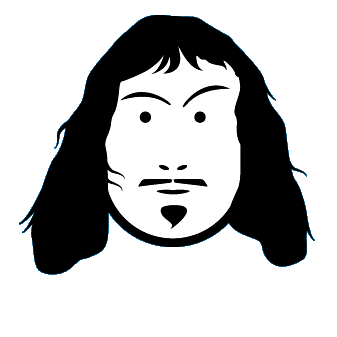
The background
- Nationality:
- French
- Schools:
- Foundationalism, Innatism, Mechanism, Rationalism
- Branchs:
- Epistemology, Metaphysics, Mathematics, Physics, Cosmology, Ethics
- Period:
- Renaissance
The synopsis
René Descartes (31 March 1596 – 11 February 1650) was a French philosopher, scientist, logician, and mathematician, widely considered a seminal figure in the emergence of modern philosophy and science during the Renaissance era. Mathematics was paramount to his method of inquiry, and he connected the previously separate fields of geometry and algebra into analytic geometry.
Refusing to accept the authority of previous philosophers, Descartes frequently set his views apart from the philosophers who preceded him. In the opening section of the "Passions of the Soul", an early modern treatise on emotions, Descartes goes so far as to assert that he will write on this topic "as if no one had written on these matters before." His best-known philosophical statement is "cogito, ergo sum" ("I think, therefore I am").
Descartes has often been called the father of modern philosophy, and he is largely seen as responsible for the increased attention given to epistemology in the 17th century. He was one of the key figures in the Scientific Revolution, and his "Meditations on First Philosophy" and other philosophical works continue to be studied. His influence in mathematics is equally apparent, being the namesake of the Cartesian coordinate system. Descartes is also credited as the father of analytic geometry, which facilitated the discovery of infinitesimal calculus and analysis.
The works
Regulae ad Directionem Ingenii
Les Météores
La Dioptrique
La Géométrie
Discours de la méthode
Meditationes de prima philosophia
Principia Philosophiae
Les Passions de l'âme
The quotes
Illusory joy is often worth more than genuine sorrow.
I think; therefore I am.
If you would be a real seeker after truth, it is necessary that at least once in your life you doubt, as far as possible, all things.
I am accustomed to sleep and in my dreams to imagine the same things that lunatics imagine when awake.
Everything is self-evident.
The first precept was never to accept a thing as true until I knew it as such without a single doubt.
Perfect numbers like perfect men are very rare.
Nothing is more fairly distributed than common sense: no one thinks he needs more of it than he already has.
When it is not in our power to follow what is true, we ought to follow what is most probable.
The two operations of our understanding, intuition and deduction, on which alone we have said we must rely in the acquisition of knowledge.
In order to improve the mind, we ought less to learn, than to contemplate.
Except our own thoughts, there is nothing absolutely in our power.
An optimist may see a light where there is none, but why must the pessimist always run to blow it out?
The reading of all good books is like a conversation with the finest minds of past centuries.
It is not enough to have a good mind; the main thing is to use it well.
The greatest minds are capable of the greatest vices as well as of the greatest virtues.
I am indeed amazed when I consider how weak my mind is and how prone to error.
Whenever anyone has offended me, I try to raise my soul so high that the offense cannot reach it.
A state is better governed which has few laws, and those laws strictly observed.
There is nothing so strange and so unbelievable that it has not been said by one philosopher or another.
Travelling is almost like talking with those of other centuries.
Divide each difficulty into as many parts as is feasible and necessary to resolve it.
Common sense is the most fairly distributed thing in the world, for each one thinks he is so well-endowed with it that even those who are hardest to satisfy in all other matters are not in the habit of desiring more of it than they already have.
Each problem that I solved became a rule, which served afterwards to solve other problems.
The senses deceive from time to time, and it is prudent never to trust wholly those who have deceived us even once.
It is only prudent never to place complete confidence in that by which we have even once been deceived.
One cannot conceive anything so strange and so implausible that it has not already been said by one philosopher or another.