The Philosopher
Ramana Maharshi
The face
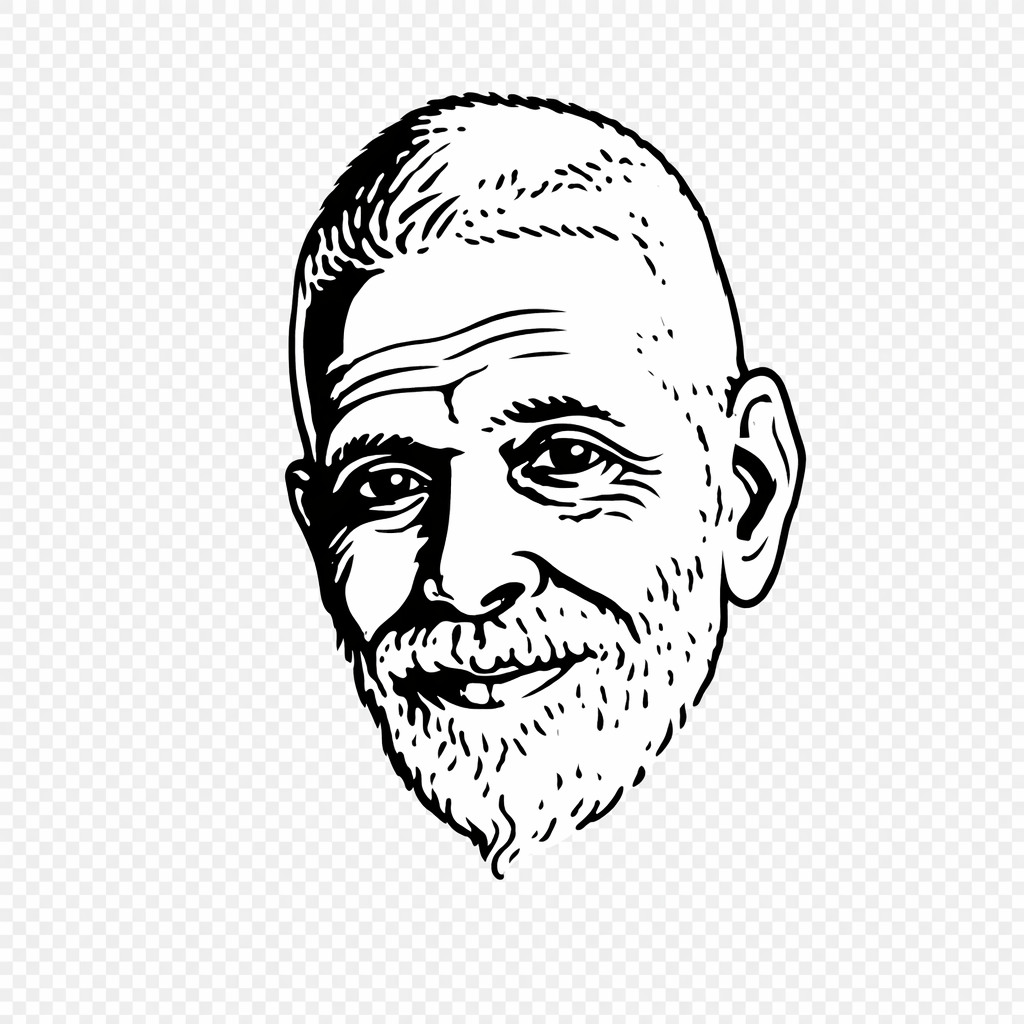
The background
- Nationality:
- Indian
- Schools:
- Advaita Vedanta
- Period:
- 20th century
The synopsis
Ramana Maharshi (1879–1950) was an Indian sage and jivanmukta (liberated being). Born Venkataraman Iyer, he is primarily known as Bhagavan Sri Ramana Maharshi. His life and teachings have had a profound impact on spiritual seekers worldwide.
Born in Tiruchuli, Tamil Nadu, India, in 1879, Venkataraman experienced a life-altering event at the age of 16. During a period of intense fear of death, he underwent a profound self-enquiry, leading him to the realization of his true Self, which he identified with a "current" or "force" that was permanent and unchanging. This realization led him to abandon his worldly life and journey to the sacred mountain of Arunachala in Tiruvannamalai, where he spent the remainder of his life.
At Arunachala, Ramana Maharshi lived a life of deep contemplation and silence, attracting a large number of devotees who regarded him as an avatar of Shiva. His primary method of spiritual instruction was through silent communion (satsang), though he also answered questions posed by his visitors. His teachings emphasized the path of self-enquiry ('Who am I?') as the most direct means to realize the Self, alongside devotion and surrender to the Divine.
Ramana Maharshi's teachings gained international recognition, particularly after Paul Brunton's book 'A Search in Secret India' (1934). His influence spread to the West, inspiring many seekers and contributing to the development of various spiritual movements. Despite his profound spiritual stature, he lived a simple and humble life, demonstrating the principles of detachment and selflessness. His legacy continues to inspire countless individuals seeking spiritual awakening and inner peace.
The works
The quotes
Let come what comes, let go what goes. See what remains.
The degree of freedom from unwanted thoughts and the degree of concentration on a single thought are the measures to gauge spiritual progress.
Time and space always change, but there is something which is eternal and changeless. For example, the world and time, past or future, nothing exists for us in sleep. But we exist. Let us try to find out that which is changeless and which always exists.
Silence is ever speaking; it is the perennial flow of language.
All bad qualities centre round the ego. When the ego is gone, Realisation results by itself. There are neither good nor bad qualities in the Self. The Self is free from all qualities. Qualities pertain to the mind only.
The body dies, but the spirit that transcends it cannot be touched by death.
Like the practice of breath control, meditation on the forms of God, repetition of mantras, food restrictions, etc., are but aids for rendering the mind quiescent.
Experiences such as, 'I went; I came; I was; I did,' come naturally to everyone. From these experiences, does it not appear that the consciousness 'I' is the subject of those various acts? Enquiry into the true nature of that consciousness, and remaining as oneself, is the way to understand, through enquiry, one's true nature.
The means that make one qualified for enquiry are meditation, yoga, etc. One should gain proficiency in these through graded practice and thus secure a stream of mental modes that is natural and helpful.
Think of God; attachments will gradually drop away. If you wait till all desires disappear before starting your devotion and prayer, you will have to wait for a very long time indeed.
Consciousness is indeed always with us. Everyone knows 'I am!' No one can deny his own being.
If you are vigilant and make a stern effort to reject every thought when it rises, you will soon find that you are going deeper and deeper into your own inner self, where there is no need for your effort to reject the thoughts.
Actions yield result by the ordinance of God as He wills.
That which comes and goes, rises and sets, is born and dies is the ego. That which always abides, never changes, and is devoid of qualities is the Self.
All activities and events that a body is to go through are determined at the time of conception.
Even as one and the same person is called by different names according to the different functions he performs, so also one and the same mind is called by the different names: mind, intellect, memory, and egoity, on account of the difference in the modes - and not because of any real difference.
Without understanding yourself, what is the use of trying to understand the world?
The best way to meditate is through meditation itself.
Concentration of the mind is in a way common to both Knowledge and Yoga. Yoga aims at union of the individual with the universal, the Reality. This Reality cannot be new. It must exist even now, and it does exist.
Devotion complete culminates in knowledge supreme.
Doubts never end. If one doubt is removed, another takes its place. It is like removing the leaves of a tree one by one. Even if all the leaves are clipped off, new ones grow. The tree itself must be uprooted.
Mind is consciousness which has put on limitations. You are originally unlimited and perfect. Later you take on limitations and become the mind.
Self-reform automatically brings about social reform.
There is no doubt that breath control is the means for mind control because the mind, like breath, is a part of air; because the nature of mobility is common to both; because the place of origin is the same for both; and because when one of them is controlled, the other gets controlled.
When there are thoughts, it is distraction: when there are no thoughts, it is meditation.
God has no resolve; no karma attaches itself to Him.
The Self is self-luminous without darkness and light, and is the reality which is self-manifest. Therefore, one should not think of it as this or as that. The very thought of thinking will end in bondage.
Who am I? Not the body, because it is decaying; not the mind, because the brain will decay with the body; not the personality, nor the emotions, for these also will vanish with death.
Time is only an idea. There is only the Reality. Whatever you think it is, it looks like that. If you call it time, it is time. If you call it existence, it is existence, and so on. After calling it time, you divide it into days and nights, months, years, hours, minutes, etc. Time is immaterial for the Path of Knowledge.
It is the Higher Power which does everything, and the man is only a tool. If he accepts that position, he is free from troubles; otherwise, he courts them.
It is every intelligent man's experience that evildoing recoils on the doer sooner or later.
Every moment there is creation, every moment destruction. There is no absolute creation, no absolute destruction. Both are movement, and that is eternal.
As instruments for knowing the objects, the sense organs are outside, and so they are called outer senses; and the mind is called the inner sense because it is inside. But the distinction between inner and outer is only with reference to the body; in truth, there is neither inner nor outer. The mind's nature is to remain pure like ether.
I am not the perishable body, but the eternal Self.
Suffering turns men towards their creator.
Silence is also conversation.
Society is the body; individuals are its members, its limbs. Just as the various limbs help and co-operate with one another and thus are happy, so each must unite with others in being helpful to all in thought, speech and action... One may see to the good of one's own group, i.e., the group that is immediate to him, and then proceed to others.
There is no doubt whatsoever that the universe is the merest illusion.
No one succeeds without effort... Those who succeed owe their success to perseverance.
The Real is ever-present, like the screen on which the cinematographic pictures move. While the picture appears on it, the screen remains invisible. Stop the picture, and the screen will become clear. All thoughts and events are merely pictures moving on the screen of Pure Consciousness, which alone is real.
Our own self-realization is the greatest service we can render the world.
The mind itself is of the form of all, i.e., of soul, God and world; when it becomes of the form of the Self through knowledge, there is release, which is of the nature of Brahman: this is the teaching.
If there is anything besides the Self there is reason to fear? Who sees the second? First, the ego arises and sees objects as external. If the ego does not rise, the Self alone exists and there is no second.
For those who have obtained unobstructed knowledge of Self, the world is seen merely as a bondage causing imagination.
I have never said that there is no need for a guru. All depends on what you call guru. He need not be in a human form.
One must realise his Self in order to open the store of unalloyed happiness.
The greatest error of a man is to think that he is weak by nature, evil by nature. Every man is divine and strong in his real nature. What are weak and evil are his habits, his desires and thoughts, but not himself.
Even the structure of the atom has been found by the mind. Therefore the mind is subtler than the atom. That which is behind the mind, namely the individual soul, is subtler than the mind.
You need not aspire for or get any new state. Get rid of your present thoughts, that is all.