The Philosopher
Leon Trotsky
The face
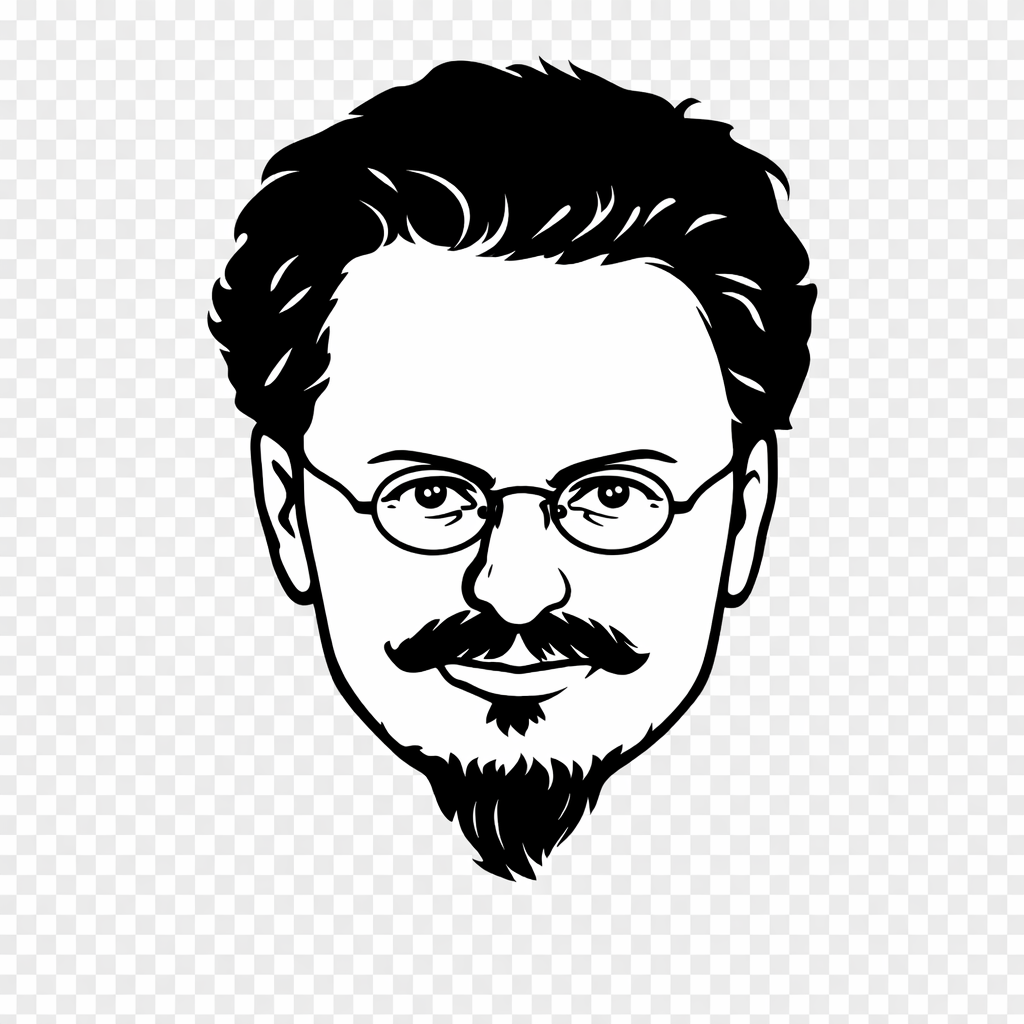
The background
- Nationality:
- Soviet
- Schools:
- Trotskyism
- Period:
- Soviet
The synopsis
Lev Davidovich Bronstein (born 7 November 1879 – died 21 August 1940), better known as Leon Trotsky, was a Russian revolutionary, Soviet politician, and political theorist. He was a key figure in the 1905 Revolution, the October Revolution of 1917, the Russian Civil War, and the establishment of the Soviet Union, from which he was exiled in 1929 before his assassination in 1940. Trotsky and Vladimir Lenin were widely considered the two most prominent figures in the Soviet state from 1917 until Lenin's death in 1924. Ideologically a Marxist and a Leninist, Trotsky's ideas and beliefs inspired a school of Marxism known as Trotskyism. He joined the Russian Social Democratic Labour Party in 1898, being arrested and exiled to Siberia for his activities. In 1902 he escaped to London, where he met Lenin. Trotsky initially sided with the Mensheviks against Lenin's Bolsheviks in the party's 1903 schism, but declared himself non-factional in 1904. During the 1905 Revolution, Trotsky was elected chairman of the Saint Petersburg Soviet. He was again exiled to Siberia, but escaped in 1907 and lived abroad. After the February Revolution of 1917, Trotsky joined the Bolsheviks and was elected chairman of the Petrograd Soviet. He helped to lead the October Revolution, and as the People's Commissar for Foreign Affairs negotiated the Treaty of Brest-Litovsk, by which Russia withdrew from World War I. He served as People's Commissar for Military Affairs from 1918 to 1925, during which he built the Red Army and led it to victory in the civil war. In 1922 Lenin formed a bloc with Trotsky against the growing Soviet bureaucracy and proposed that he should become a deputy premier, but Trotsky declined. Beginning in 1923, Trotsky led the party's Left Opposition faction, which supported greater levels of industrialisation, voluntary collectivisation and party democratisation in a shared framework with the New Economic Policy. After Lenin's death in 1924, Trotsky emerged as a prominent critic of Joseph Stalin, who soon politically outmanoeuvred him. Trotsky was expelled from the Politburo in 1926 and from the party in 1927, exiled to Alma Ata in 1928 and deported in 1929. He lived in Turkey, France, and Norway before settling in Mexico in 1937. In exile, Trotsky wrote polemics against Stalinism, advocating proletarian internationalism against Stalin's theory of socialism in one country. Trotsky's theory of permanent revolution held that the revolution could survive only if it spread to more advanced capitalist countries. In *The Revolution Betrayed* (1936), he argued that the Soviet Union had become a "degenerated workers' state", and in 1938 founded the Fourth International as an alternative to the Comintern. After being sentenced to death in absentia at the Moscow show trials in 1936, Trotsky was assassinated in 1940 in Mexico City by Ramón Mercader, a Stalinist agent.
The works
Our Political Tasks
Our Revolution
1905
The Permanent Revolution and Results and Prospects
Terrorism and Communism
Trotsky's Military Writings
Problems of Everyday Life
Literature and Revolution
New Course
Lessons of October
Towards Socialism or Capitalism?
Leon Trotsky on China
My Life
The Permanent Revolution
History of the Russian Revolution
The Revolution Betrayed
The Stalin School of Falsification
Their Morals and Ours: The class foundations of moral practice
The Transitional Program
Stalin: An Appraisal of the Man and His Influence
The Spanish Revolution, 1931–1939
The Struggle Against Fascism in Germany
In Defence of Marxism (book)
Thesis of Pulacayo
The Stalinist Legacy
The Dilemmas of Lenin
The quotes
The end may justify the means as long as there is something that justifies the end.
Fascism is nothing but capitalist reaction.
The depth and strength of a human character are defined by its moral reserves. People reveal themselves completely only when they are thrown out of the customary conditions of their life, for only then do they have to fall back on their reserves.
The masses go into a revolution not with a prepared plan of social reconstruction, but with a sharp feeling that they cannot endure the old regime. Only the guiding layers of a class have a political program, and even this still requires the test of events and the approval of the masses.
From being a patriotic myth, the Russian people have become an awful reality.
Revolutions are always verbose.
The dynamic of revolutionary events is directly determined by swift, intense, and passionate changes in the psychology of classes which have already formed themselves before the revolution.
The historic ascent of humanity, taken as a whole, may be summarized as a succession of victories of consciousness over blind forces - in nature, in society, in man himself.
Ideas that enter the mind under fire remain there securely and for ever.
There are no absolute rules of conduct, either in peace or war. Everything depends on circumstances.
If we had more time for discussion we should probably have made a great many more mistakes.
Technique is noticed most markedly in the case of those who have not mastered it.
Everyone has the right to be stupid on occasion, but Comrade Macdonald abuses the privilege.
Old age is the most unexpected of all things that happen to a man.
Life is not an easy matter... You cannot live through it without falling into frustration and cynicism unless you have before you a great idea which raises you above personal misery, above weakness, above all kinds of perfidy and baseness.
Where force is necessary, there it must be applied boldly, decisively and completely. But one must know the limitations of force; one must know when to blend force with a maneuver, a blow with an agreement.
There is a limit to the application of democratic methods. You can inquire of all the passengers as to what type of car they like to ride in, but it is impossible to question them as to whether to apply the brakes when the train is at full speed and accident threatens.
England is nothing but the last ward of the European madhouse, and quite possibly it will prove to be the ward for particularly violent cases.
You may not be interested in strategy, but strategy is interested in you.
Insurrection is an art, and like all arts has its own laws.
In a serious struggle there is no worse cruelty than to be magnanimous at an inopportune time.
Let a man find himself, in distinction from others, on top of two wheels with a chain - at least in a poor country like Russia - and his vanity begins to swell out like his tires. In America it takes an automobile to produce this effect.
Learning carries within itself certain dangers because out of necessity one has to learn from one's enemies.
Events can neither be regarded as a series of adventures nor strung on the thread of a preconceived moral. They must obey their own laws.