The Philosopher
Karl Marx
The face
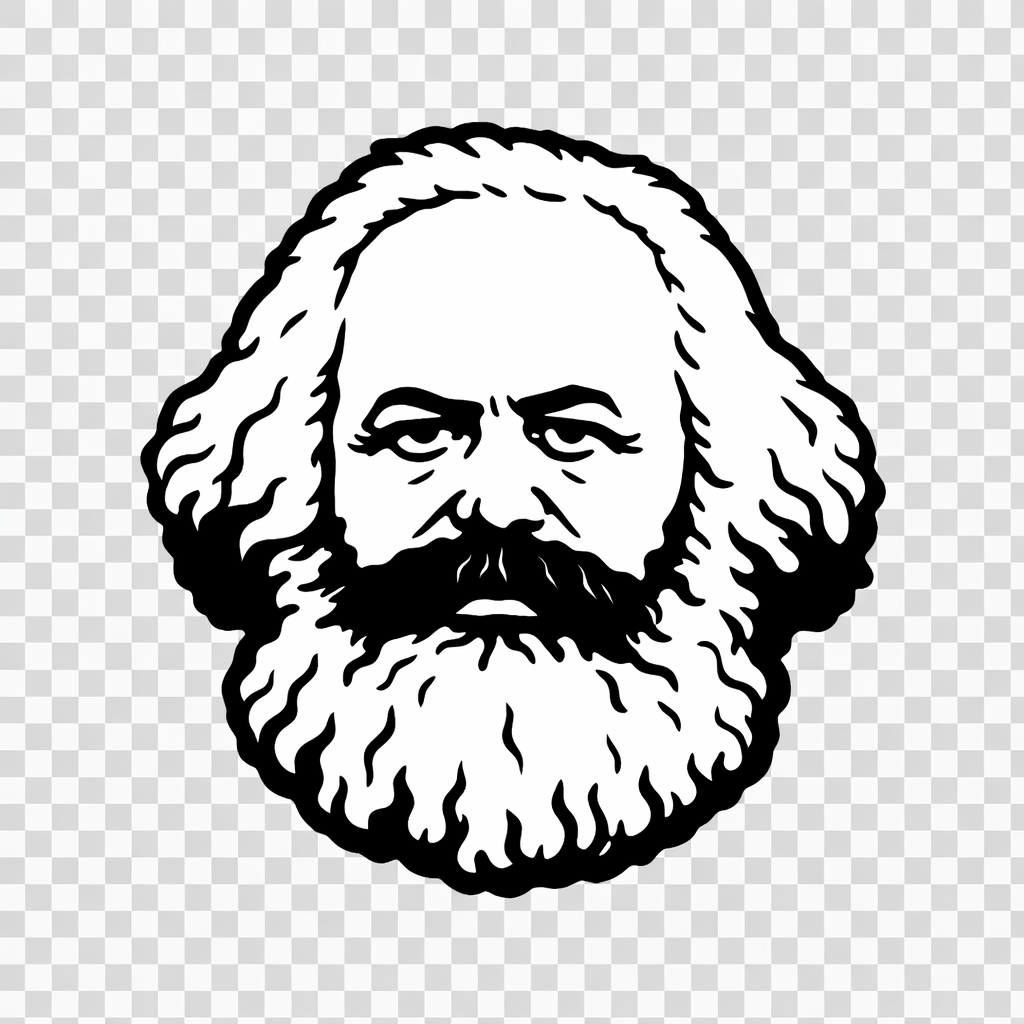
The background
- Nationality:
- Prussian, Stateless
- Schools:
- Political economy, Marxism, Young Hegelianism
- Branchs:
- Philosophy, Economics, History, Politics, Revolutionary socialism, Sociology
- Period:
- 19th-century
The synopsis
Karl Marx was a German philosopher, social and political theorist, economist, historian, journalist, and revolutionary socialist. He developed the theory of historical materialism, analyzing class struggle under capitalism and predicting its overthrow by the proletariat in favor of communism. Marx co-authored The Communist Manifesto (1848) with Friedrich Engels and critiqued classical political economy in his magnum opus, Das Kapital (1867–1894). Born in Trier, Prussia, Marx earned a doctoral degree in philosophy from the University of Jena in 1841. Influenced by Hegelianism, he developed his own materialist philosophy, emphasizing the role of economic factors and class conflict in shaping history. Marx's life was marked by political activism and exile, leading him to live in Paris, Brussels, and finally London, where he spent the latter half of his life. His work has had an immense impact on socialist thought, political movements, and various academic disciplines, including economics, sociology, and history.
The works
The Difference Between the Democritean and Epicurean Philosophy of Nature
Critique of Hegel's Philosophy of Right
On the Jewish Question
Economic and Philosophic Manuscripts of 1844
The Holy Family
Theses on Feuerbach
The German Ideology
The Poverty of Philosophy
The Communist Manifesto
The Class Struggles in France
The Eighteenth Brumaire of Louis Bonaparte
Grundrisse
A Contribution to the Critique of Political Economy
Value, Price and Profit
Das Kapital
The Civil War in France
Critique of the Gotha Programme
The quotes
History repeats itself, first as tragedy, second as farce.
Workers of the world unite; you have nothing to lose but your chains.
Necessity is blind until it becomes conscious. Freedom is the consciousness of necessity.
Capital is dead labor, which, vampire-like, lives only by sucking living labor, and lives the more, the more labor it sucks.
The meaning of peace is the absence of opposition to socialism.
The history of all previous societies has been the history of class struggles.
Revolutions are the locomotives of history.
It is absolutely impossible to transcend the laws of nature. What can change in historically different circumstances is only the form in which these laws expose themselves.
Religion is the impotence of the human mind to deal with occurrences it cannot understand.
For the bureaucrat, the world is a mere object to be manipulated by him.
The development of civilization and industry in general has always shown itself so active in the destruction of forests that everything that has been done for their conservation and production is completely insignificant in comparison.
The writer must earn money in order to be able to live and to write, but he must by no means live and write for the purpose of making money.
While the miser is merely a capitalist gone mad, the capitalist is a rational miser.
The English have all the material requisites for the revolution. What they lack is the spirit of generalization and revolutionary ardour.
Greek philosophy seems to have met with something with which a good tragedy is not supposed to meet, namely, a dull ending.
Men's ideas are the most direct emanations of their material state.
Natural science will in time incorporate into itself the science of man, just as the science of man will incorporate into itself natural science: there will be one science.
A specter is haunting Europe - the specter of communism.
The writer may very well serve a movement of history as its mouthpiece, but he cannot of course create it.
The country that is more developed industrially only shows, to the less developed, the image of its own future.
Capital is money, capital is commodities. By virtue of it being value, it has acquired the occult ability to add value to itself. It brings forth living offspring, or, at the least, lays golden eggs.
A commodity appears at first sight an extremely obvious, trivial thing. But its analysis brings out that it is a very strange thing, abounding in metaphysical subtleties and theological niceties.
The ideas of the ruling class are in every epoch the ruling ideas, i.e., the class which is the ruling material force of society, is at the same time its ruling intellectual force.
The more the division of labor and the application of machinery extend, the more does competition extend among the workers, the more do their wages shrink together.
In bourgeois society capital is independent and has individuality, while the living person is dependent and has no individuality.
Landlords, like all other men, love to reap where they never sowed.
If anything is certain, it is that I myself am not a Marxist.
Capitalist production, therefore, develops technology, and the combining together of various processes into a social whole, only by sapping the original sources of all wealth - the soil and the labourer.
The theory of Communism may be summed up in one sentence: Abolish all private property.
Religion is the sigh of the oppressed creature, the heart of a heartless world, and the soul of soulless conditions. It is the opium of the people.
Democracy is the road to socialism.
The production of too many useful things results in too many useless people.
Religion is the opium of the masses.
Anyone who knows anything of history knows that great social changes are impossible without feminine upheaval. Social progress can be measured exactly by the social position of the fair sex, the ugly ones included.
The rich will do anything for the poor but get off their backs.
We should not say that one man's hour is worth another man's hour, but rather that one man during an hour is worth just as much as another man during an hour. Time is everything, man is nothing: he is at the most time's carcass.
Capital is reckless of the health or length of life of the laborer, unless under compulsion from society.
In a higher phase of communist society... only then can the narrow horizon of bourgeois right be fully left behind and society inscribe on its banners: from each according to his ability, to each according to his needs.
Society does not consist of individuals but expresses the sum of interrelations, the relations within which these individuals stand.
Let the ruling classes tremble at a communist revolution. The proletarians have nothing to lose but their chains. They have a world to win. Workingmen of all countries, unite!
The ruling ideas of each age have ever been the ideas of its ruling class.
On a level plain, simple mounds look like hills; and the insipid flatness of our present bourgeoisie is to be measured by the altitude of its great intellects.
Machines were, it may be said, the weapon employed by the capitalists to quell the revolt of specialized labor.
There is a specter haunting Europe, the specter of Communism.
It is not history which uses men as a means of achieving - as if it were an individual person - its own ends. History is nothing but the activity of men in pursuit of their ends.
Social progress can be measured by the social position of the female sex.
The only antidote to mental suffering is physical pain.
From each according to his abilities, to each according to his needs.
Reason has always existed, but not always in a reasonable form.
The first requisite for the happiness of the people is the abolition of religion.
Art is always and everywhere the secret confession, and at the same time the immortal movement of its time.
Nothing can have value without being an object of utility.
The worker of the world has nothing to lose, but their chains, workers of the world unite.
History does nothing; it does not possess immense riches, it does not fight battles. It is men, real, living, who do all this.
Without doubt, machinery has greatly increased the number of well-to-do idlers.
Medicine heals doubts as well as diseases.
Experience praises the most happy the one who made the most people happy.
The product of mental labor - science - always stands far below its value, because the labor-time necessary to reproduce it has no relation at all to the labor-time required for its original production.