The Philosopher
Isaac Newton
The face
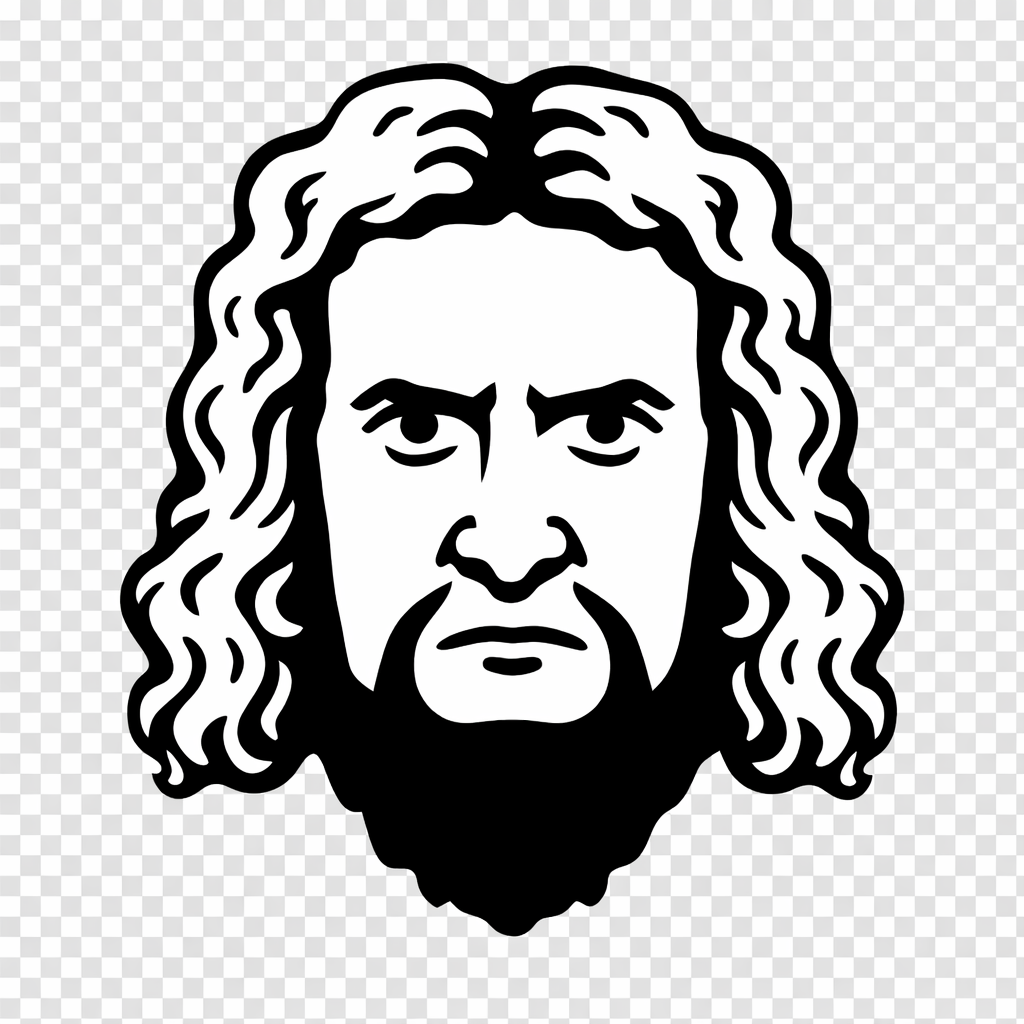
The background
- Nationality:
- English
- Schools:
- Newtonianism
- Branchs:
- Physics, Natural Philosophy, Alchemy, Theology, Mathematics, Astronomy, Economics, Optics
The synopsis
Sir Isaac Newton was an English polymath: mathematician, physicist, astronomer, alchemist, theologian, author, and inventor. He was a central figure in the Scientific Revolution and the Enlightenment. His book "Philosophiæ Naturalis Principia Mathematica" (1687) established classical mechanics and universal gravitation, unifying physics. Newton also made seminal contributions to optics and infinitesimal calculus. He refined the scientific method, bringing forth modern science. His laws of motion and gravitation were the dominant scientific viewpoint for centuries. Newton built the first reflecting telescope and developed a sophisticated theory of colour based on prism experiments. He also formulated an empirical law of cooling and pioneered vector analysis.
The works
De analysi per aequationes numero terminorum infinitas
De motu corporum in gyrum
Philosophiæ Naturalis Principia Mathematica
Opticks
Arithmetica Universalis
De mundi systemate
Observations on Daniel and The Apocalypse of St. John
An Historical Account of Two Notable Corruptions of Scripture
The quotes
If I have seen further than others, it is by standing upon the shoulders of giants.
I do not know what I may appear to the world, but to myself I seem to have been only like a boy playing on the seashore, and diverting myself in now and then finding a smoother pebble or a prettier shell than ordinary, whilst the great ocean of truth lay all undiscovered before me.
To every action there is always opposed an equal reaction.
Atheism is so senseless. When I look at the solar system, I see the earth at the right distance from the sun to receive the proper amounts of heat and light. This did not happen by chance.
Genius is patience.
Plato is my friend; Aristotle is my friend, but my greatest friend is truth.
I do not know what I may appear to the world; but to myself, I seem to have been only like a boy playing on the seashore, and diverting myself now and then in finding a smoother pebble or prettier shell than ordinary, while the great ocean of truth lay all undiscovered before me.
To explain all nature is too difficult a task for any one man or even for any one age. 'Tis much better to do a little with certainty & leave the rest for others that come after you.
Christ comes as a thief in the night, & it is not for us to know the times & seasons which God hath put into his own breast.
Fidelity and allegiance sworn to the King is only such a fidelity and obedience as is due to him by the law of the land; for were that faith and allegiance more than what the law requires, we would swear ourselves slaves and the King absolute; whereas, by the law, we are free men, notwithstanding those oaths.
The moon gravitates towards the earth and by the force of gravity is continually drawn off from a rectilinear motion and retained in its orbit.
It may be that there is no such thing as an equable motion, whereby time may be accurately measured. All motions may be accelerated or retarded, but the true, or equable, progress of absolute time is liable to no change.
The same thing is to be understood of all bodies, revolved in any orbits. They all endeavour to recede from the centres of their orbits, and were it not for the opposition of a contrary force which restrains them to and detains them in their orbits, which I therefore call Centripetal, would fly off in right lines with a uniform motion.
Why there is one body in our System qualified to give light and heat to all the rest, I know no reason but because the Author of the System thought it convenient; and why there is but one body of this kind, I know no reason, but because one was sufficient to warm and enlighten all the rest.
Absolute space, in its own nature, without regard to anything external, remains always similar and immovable. Relative space is some movable dimension or measure of the absolute spaces, which our senses determine by its position to bodies, and which is vulgarly taken for immovable space.
If a projectile were deprived of the force of gravity, it would not be deflected toward the earth but would go off in a straight line into the heavens and do so with uniform motion, provided that the resistance of the air were removed.
I have explained the phenomena of the heavens and of our sea by the force of gravity, but I have not yet assigned a cause to gravity.
It is reasonable that forces directed toward bodies depend on the nature and the quantity of matter of such bodies, as happens in the case of magnetic bodies.
Resistance is usually ascribed to bodies at rest, and impulse to those in motion, but motion and rest, as commonly conceived, are only relatively distinguished; nor are those bodies always truly at rest, which commonly are taken to be so.
In experimental philosophy, we are to look upon propositions inferred by general induction from phenomena as accurately or very nearly true, notwithstanding any contrary hypotheses that may be imagined, till such time as other phenomena occur by which they may either be made more accurate or liable to exceptions.
The description of right lines and circles, upon which geometry is founded, belongs to mechanics. Geometry does not teach us to draw these lines, but requires them to be drawn.
That the divided but contiguous particles of bodies may be separated from one another is a matter of observation; and, in the particles that remain undivided, our minds are able to distinguish yet lesser parts, as is mathematically demonstrated.
God is the same God, always and everywhere. He is omnipresent not virtually only, but also substantially, for virtue cannot subsist without substance.
Just as the system of the sun, planets and comets is put in motion by the forces of gravity, and its parts persist in their motions, so the smaller systems of bodies also seem to be set in motion by other forces and their particles to be variously moved in relation to each other and, especially, by the electric force.
God in the beginning formed matter in solid, massy, hard, impenetrable, movable particles, of such sizes and figures, and with such other properties, and in such proportion to space, as most conduced to the end for which he formed them.
A man may imagine things that are false, but he can only understand things that are true, for if the things be false, the apprehension of them is not understanding.
As a blind man has no idea of colors, so have we no idea of the manner by which the all-wise God perceives and understands all things.
If I have done the public any service, it is due to my patient thought.
Tact is the art of making a point without making an enemy.
An object in motion tends to remain in motion along a straight line unless acted upon by an outside force.
We build too many walls and not enough bridges.
To me there has never been a higher source of earthly honor or distinction than that connected with advances in science.
In the absence of any other proof, the thumb alone would convince me of God's existence.
I have a fundamental belief in the Bible as the Word of God, written by those who were inspired. I study the Bible daily.
Truth is ever to be found in simplicity, and not in the multiplicity and confusion of things.
All variety of created objects which represent order and life in the universe could happen only by the willful reasoning of its original Creator, whom I call the 'Lord God.'
Opposite to godliness is atheism in profession, and idolatry in practice. Atheism is so senseless and odious to mankind, that it never had many professors.
There are more sure marks of authenticity in the Bible that in any profane history.
Errors are not in the art but in the artificers.
I do not love to be printed on every occasion, much less to be dunned and teased by foreigners about mathematical things or to be thought by our own people to be trifling away my time about them when I should be about the king's business.
The best and safest method of philosophizing seems to be first to inquire diligently into the properties of things, and establishing those properties by experiments, and then to proceed more slowly to hypotheses for the explanation of them.
Religion and philosophy are to be preserved distinct. We are not to introduce divine revelations into philosophy, nor philosophical opinions into religion.
The Ignis Fatuus is a vapor shining without heat.
The centre of the system of the world is immovable.
Nothing can be divided into more parts than it can possibly be constituted of. But matter (i.e. finite) cannot be constituted of infinite parts.
We account the Scriptures of God to be the most sublime philosophy.
I can calculate the motion of heavenly bodies, but not the madness of people.
What goes up must come down.
My powers are ordinary. Only my application brings me success.
This most beautiful system of the sun, planets, and comets, could only proceed from the counsel and dominion of an intelligent and powerful Being.
The proper method for inquiring after the properties of things is to deduce them from experiments.
Gravity may put the planets into motion, but without the divine Power, it could never put them into such a circulating motion as they have about the Sun; and therefore, for this as well as other reasons, I am compelled to ascribe the frame of this System to an intelligent Agent.
God made and governs the world invisibly, and has commanded us to love and worship him and no other God; to honor our parents and masters, and love our neighbours as ourselves; and to be temperate, just, and peaceable, and to be merciful even to brute beasts.
If the experiments which I urge be defective, it cannot be difficult to show the defects; but if valid, then by proving the theory, they must render all objections invalid.
The motions which the planets now have could not spring from any natural cause alone, but were impressed by an intelligent Agent.
The motions of the comets are exceedingly regular, and they observe the same laws as the motions of the planets, but they differ from the motions of vortices in every particular and are often contrary to them.
The hypothesis of matter's being at first evenly spread through the heavens is, in my opinion, inconsistent with the hypothesis of innate gravity without a supernatural power to reconcile them, and therefore, it infers a deity.
The word 'God' usually signifies 'Lord', but every lord is not a God. It is the dominion of a spiritual being which constitutes a God: a true, supreme, or imaginary dominion makes a true, supreme, or imaginary God.
The ancients considered mechanics in a twofold respect: as rational, which proceeds accurately by demonstration, and practical. To practical mechanics all the manual arts belong, from which mechanics took its name.