The Philosopher
Georg Wilhelm Friedrich Hegel
The face
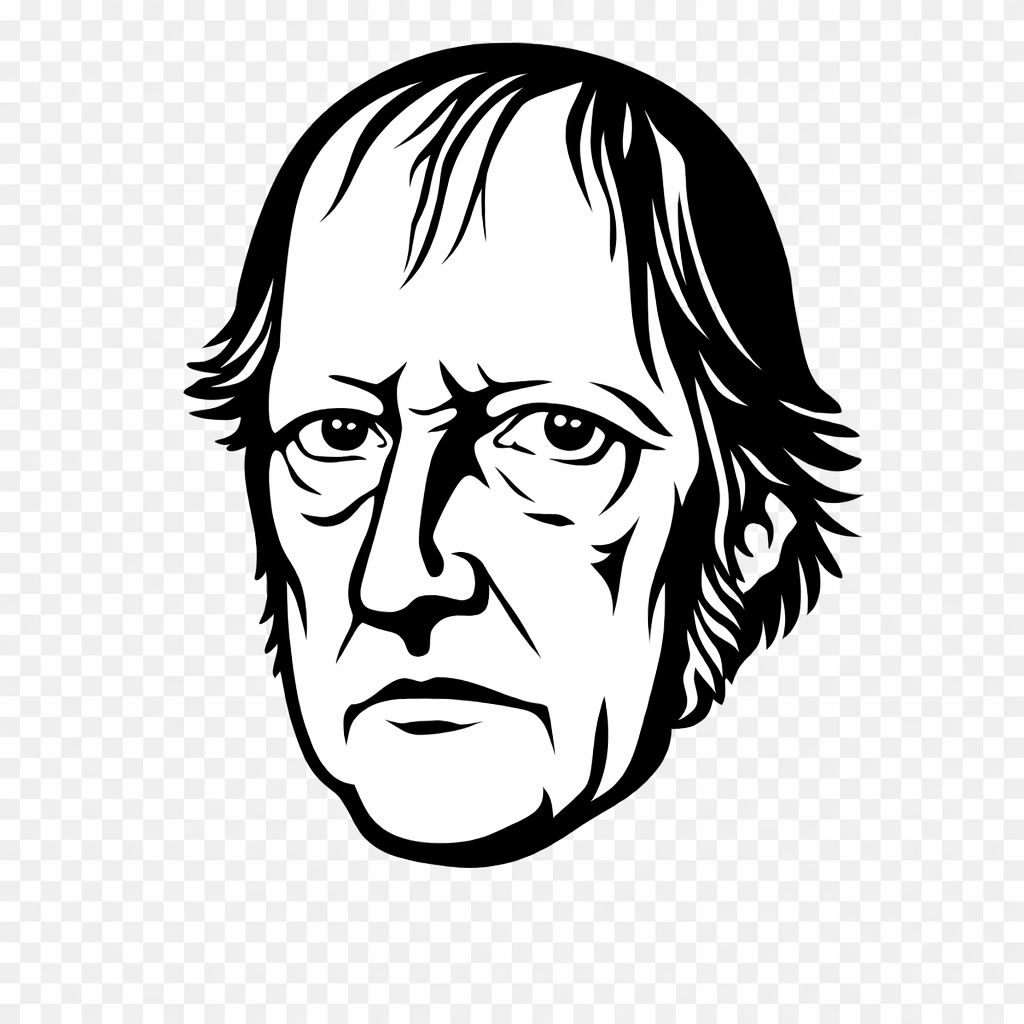
The background
- Nationality:
- German
- Schools:
- Absolute idealism, German idealism
- Branchs:
- Metaphysics, Epistemology, Ontology, Political philosophy, Philosophy of art, Philosophy of religion
- Period:
- 19th-century philosophy
The synopsis
Georg Wilhelm Friedrich Hegel (1770–1831) was a German philosopher and a major figure in German idealism. His influence on Western philosophy is extensive, covering metaphysics, epistemology, ontology, political philosophy, philosophy of art, and philosophy of religion. Born in Stuttgart, his life bridged the Enlightenment and Romanticism, influenced by the French Revolution and Napoleonic Wars. Hegel sought to overcome dualisms in modern philosophy, proposing absolute idealism, a unified system where 'spirit' (*Geist*) develops through history, leading to self-knowledge. His method, often called dialectical or speculative, involves assessing concepts for internal contradictions, resolving them into higher unities. Major works include 'Phenomenology of Spirit' (1807) and 'Science of Logic' (1812–1816). He famously stated that "world history is progress in the consciousness of freedom." After his death, his followers split into "Right" and "Left" Hegelian camps, with the Left, including Marx, adapting his dialectic for materialist critiques. His thought profoundly impacted subsequent philosophy, including critical theory and existentialism.
The works
The Phenomenology of Spirit
Science of Logic
Encyclopaedia of the Philosophical Sciences in Basic Outline
Elements of the Philosophy of Right