The Philosopher
Fyodor Dostoevsky
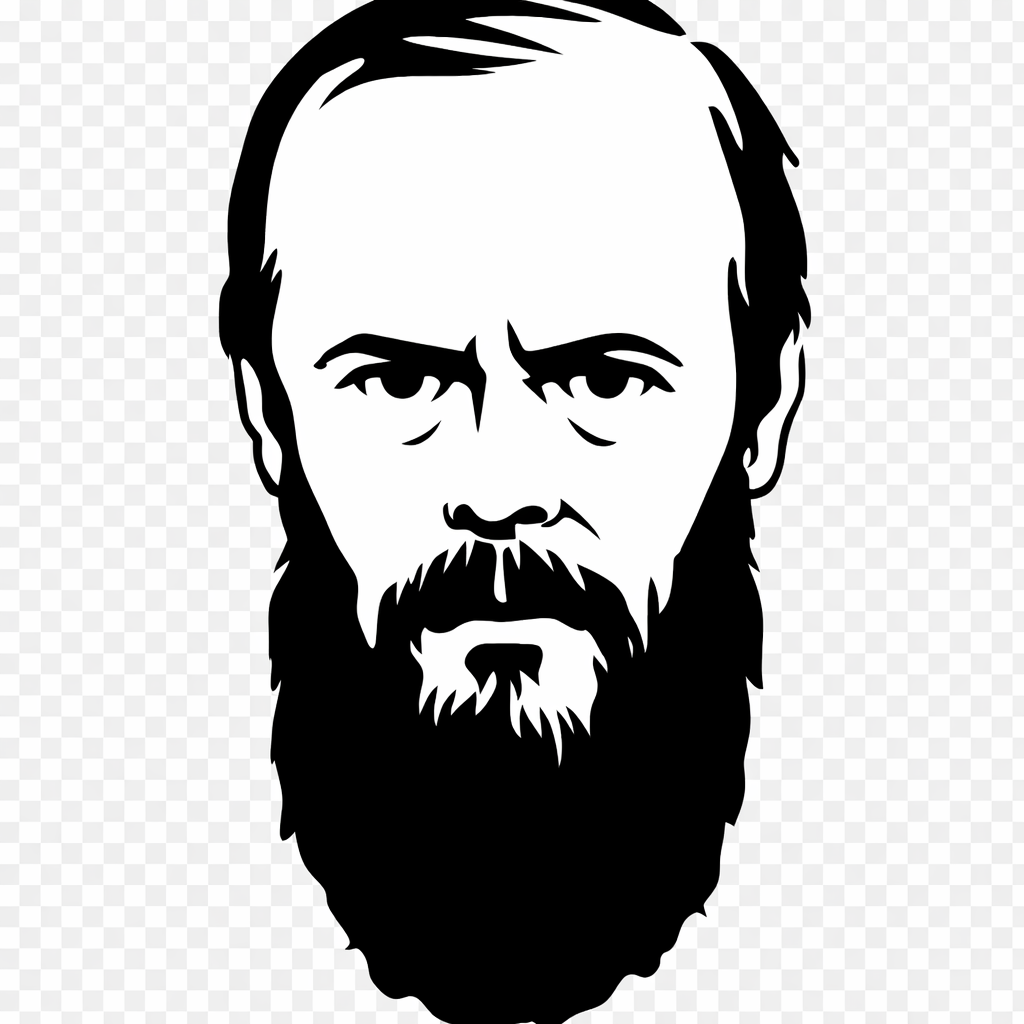
The face
The background
- Nationality:
- Russian
- Schools:
- Realism, naturalism
- Branchs:
- Psychological fiction, Existentialism
- Period:
- 19th century
The synopsis
Fyodor Mikhailovich Dostoevsky (1821–1881) was a Russian philosopher, novelist, short story writer, essayist, and journalist. He is regarded as one of the greatest novelists in both Russian and world literature, and many of his works are considered highly influential masterpieces. Dostoevsky's literary works explore the human condition in the troubled political, social, and spiritual atmospheres of 19th-century Russia, and engage with a variety of philosophical and religious themes. His most acclaimed novels include Crime and Punishment (1866), The Idiot (1869), Demons (1872), The Adolescent (1875), and The Brothers Karamazov (1880). His Notes from Underground, a novella published in 1864, is considered one of the first works of existentialist literature. Born in Moscow in 1821, Dostoevsky was introduced to literature at an early age through fairy tales and legends and through books by Russian and foreign authors. His mother died in 1837, and around the same time, he left school to enter the Nikolayev Military Engineering Institute. After graduating, he worked as an engineer and briefly enjoyed a lavish lifestyle, translating books to earn extra money. In the mid-1840s, he wrote his first novel, Poor Folk, which gained him entry into Saint Petersburg's literary circles. However, he was arrested in 1849 for belonging to a literary group, the Petrashevsky Circle, that discussed banned books critical of Tsarist Russia. Dostoevsky was sentenced to death, but the sentence was commuted at the last moment. He spent four years in a Siberian hard labour camp, which inspired him to write The House of the Dead. Aside from the labour camp, he also served six years of compulsory military service in exile. In the following years, Dostoevsky worked as a journalist, publishing and editing several magazines of his own and later A Writer's Diary. He began to travel around Western Europe and developed a gambling addiction, which led to financial hardship. For a time, he had to beg for money, but he eventually became one of the most widely read and highly regarded Russian writers.
The works
Notes from Underground
Crime and Punishment
The Idiot
Demons
The Brothers Karamazov
A Writer's Diary
Poor Folk
The quotes
Power is given only to those who dare to lower themselves and pick it up. Only one thing matters, one thing; to be able to dare!
Beauty is mysterious as well as terrible. God and devil are fighting there, and the battlefield is the heart of man.
Deprived of meaningful work, men and women lose their reason for existence; they go stark, raving mad.
Man only likes to count his troubles, but he does not count his joys.
A novel is a work of poetry. In order to write it, one must have tranquility of spirit and of impression.
Men do not accept their prophets and slay them, but they love their martyrs and worship those whom they have tortured to death.
A real gentleman, even if he loses everything he owns, must show no emotion. Money must be so far beneath a gentleman that it is hardly worth troubling about.
One can know a man from his laugh, and if you like a man's laugh before you know anything of him, you may confidently say that he is a good man.
Happiness does not lie in happiness, but in the achievement of it.
If there is no God, everything is permitted.
We sometimes encounter people, even perfect strangers, who begin to interest us at first sight, somehow suddenly, all at once, before a word has been spoken.
It seems, in fact, as though the second half of a man's life is made up of nothing, but the habits he has accumulated during the first half.
The cleverest of all, in my opinion, is the man who calls himself a fool at least once a month.
There are things which a man is afraid to tell even to himself, and every decent man has a number of such things stored away in his mind.
Man is fond of counting his troubles, but he does not count his joys. If he counted them up as he ought to, he would see that every lot has enough happiness provided for it.
Man, so long as he remains free, has no more constant and agonizing anxiety than find as quickly as possible someone to worship.