The Philosopher
Friedrich Engels
The face
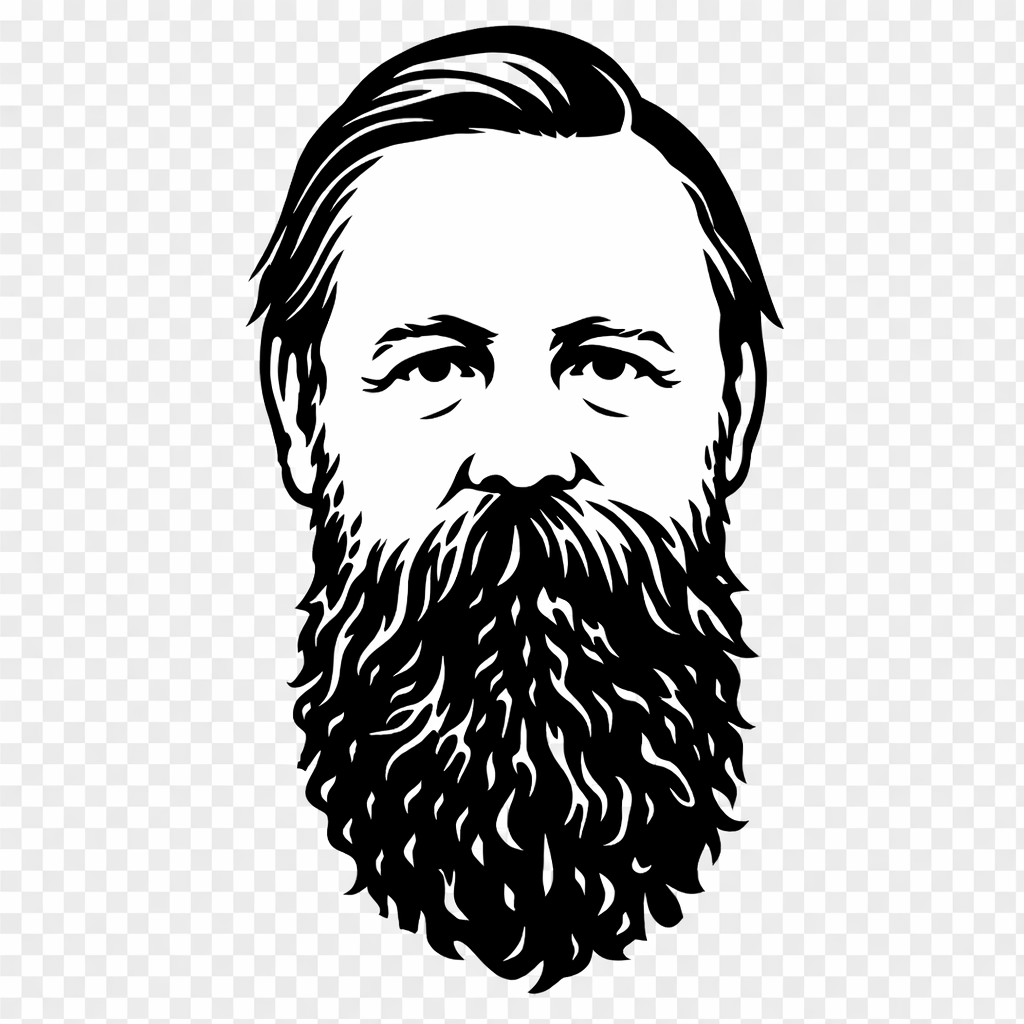
The background
- Nationality:
- German
- Schools:
- Marxism, Continental philosophy
- Branchs:
- Marxism, Socialism, Communism, Political philosophy, Political economy, History, Sociology, Anthropology, Natural science
- Period:
- 19th-century philosophy
The synopsis
Friedrich Engels (born 28 November 1820 – died 5 August 1895) was a German philosopher, social and political theorist, journalist, businessman, and revolutionary socialist. He is best known for his lifelong collaboration with Karl Marx, with whom he co-authored The Communist Manifesto (1848) and developed the political and philosophical system that came to be known as Marxism. After Marx's death, Engels served as the editor of his works, completing the second and third volumes of Das Kapital. Born in Barmen, Prussia, to a prosperous mercantile family, Engels rejected his family's devoutly pietistic values from a young age. He became involved with the Young Hegelians while performing military service in Berlin and embraced a materialist philosophy. In 1842, his father sent him to Manchester, England, to work in a cotton mill. His experiences of the industrial working class there led him to write his first major work, The Condition of the Working Class in England (1845). In 1844, Engels began a permanent partnership with Marx in Paris. Together they worked to critique the prevailing idealist philosophies and develop their materialist conception of history. They became active in the Communist League, which commissioned them to write the Manifesto. Engels participated actively in the Revolutions of 1848, including in armed combat, before being forced into exile in England. From 1850, he lived in Manchester and worked for the family firm Ermen & Engels for two decades, leading a double life as a respectable cotton merchant while providing crucial financial support to the impoverished Marx family in London. After retiring in 1870, Engels moved to London and took on a central role in the International Workingmen's Association. Following Marx's death in 1883, he devoted the rest of his life to editing Marx's writings and acting as the leading authority on their shared philosophy. His own works, particularly Anti-Dühring (1878) and Socialism: Utopian and Scientific (1880), were instrumental in popularizing Marxism and became foundational texts for the Second International. Engels's application of dialectics to science in works like Dialectics of Nature was later controversially developed into the state ideology of the Soviet Union. He died of cancer in London in 1895.
The works
The Condition of the Working Class in England
The Holy Family
The German Ideology
The Communist Manifesto
The Peasant War in Germany
Revolution and Counter-Revolution in Germany
Dialectics of Nature
Anti-Dühring
Socialism: Utopian and Scientific
The Origin of the Family, Private Property and the State
Ludwig Feuerbach and the End of Classical German Philosophy
Das Kapital, Volumes II and III
The quotes
Freedom is the recognition of necessity.
The state is nothing but an instrument of opression of one class by another - no less so in a democratic republic than in a monarchy.
Everything must justify its existence before the judgment seat of Reason, or give up existence.
Some laws of state aimed at curbing crime are even more criminal.
The state is not abolished, it withers away.
Just as Darwin discovered the law of development of organic nature, so Marx discovered the law of development of human history: the simple fact, hitherto concealed by an overgrowth of ideology, that mankind must first of all eat, drink, have shelter and clothing, before it can pursue politics, science, art, religion, etc.
From the first day to this, sheer greed was the driving spirit of civilization.
Look at the Paris Commune. That was the Dictatorship of the Proletariat.
All history has been a history of class struggles between dominated classes at various stages of social development.
The proletariat uses the State not in the interests of freedom but in order to hold down its adversaries, and as soon as it becomes possible to speak of freedom the State as such ceases to exist.