The Philosopher
Ernst Schröder
The face
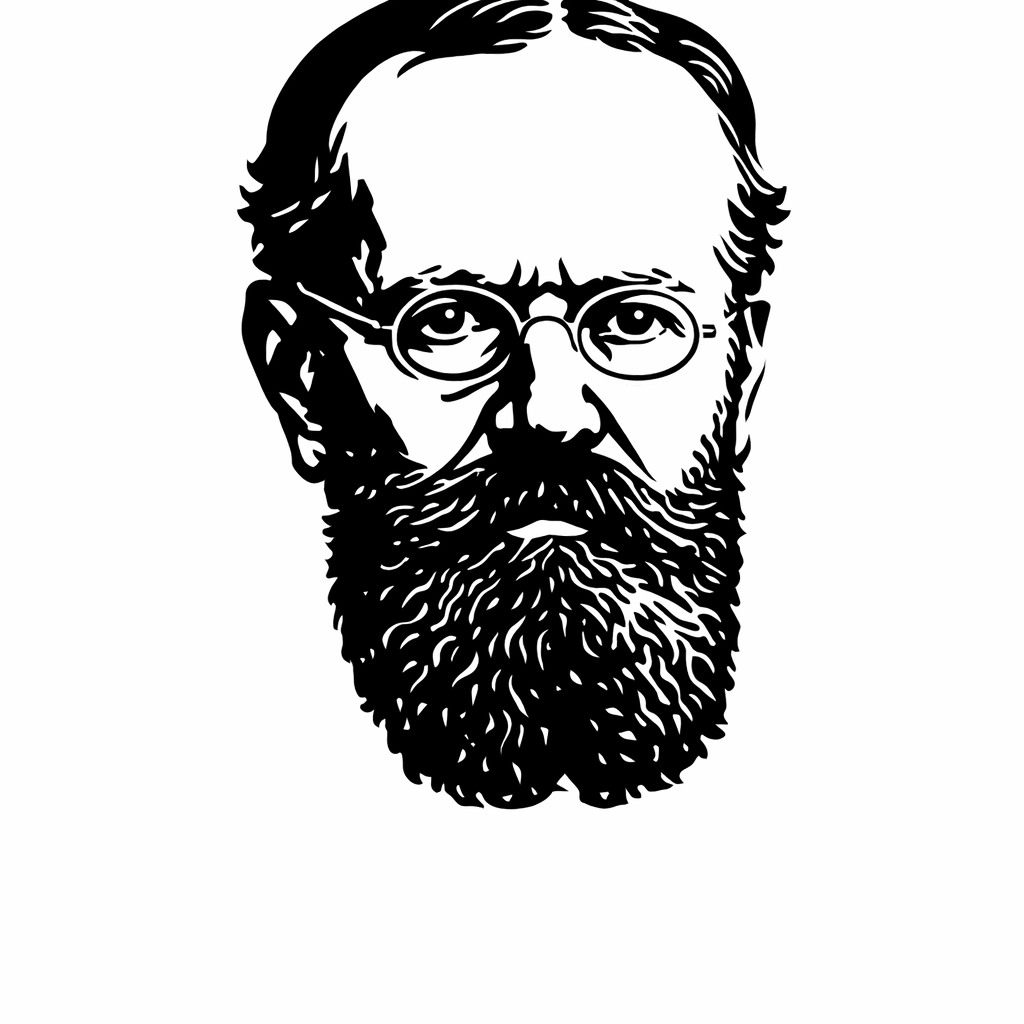
The background
- Nationality:
- German
- Branchs:
- Algebraic logic, Mathematical logic, Set theory, Lattice theory, Ordered sets, Ordinal numbers, Algebra
- Period:
- 19th century
The synopsis
Friedrich Wilhelm Karl Ernst Schröder (25 November 1841 – 16 June 1902) was a German mathematician renowned for his contributions to algebraic logic. He built upon and synthesized the work of earlier logicians such as George Boole, Augustus De Morgan, Hugh MacColl, and particularly Charles Sanders Peirce. Schröder's most significant achievement is his three-volume 'Vorlesungen über die Algebra der Logik' (Lectures on the Algebra of Logic, 1890–1905), which systematically organized the formal logical systems of his time, paving the way for mathematical logic to emerge as a separate discipline in the 20th century. His education in mathematics took place at Heidelberg, Königsberg, and Zürich. After a brief period of teaching, he held academic positions at the Technische Hochschule Darmstadt and later at the Karlsruhe Polytechnische Schule, where he remained for the rest of his career. He never married. Schröder's early work on formal logic was initially independent of British logicians but later incorporated ideas from Boole and De Morgan, as well as concepts like subsumption and quantification from Peirce. Beyond logic, he made original contributions to algebra, set theory, lattice theory, ordered sets, and ordinal numbers. Notably, he co-discovered the Cantor–Bernstein–Schröder theorem with Georg Cantor. His exposition of Boole's ideas was influential in introducing this work to continental European readers. Schröder emphasized the concept of duality in logic and developed Boole's algebra into a calculus of relations, introducing concepts like composition of relations. His stated aim was to develop logic into a calculational discipline, facilitating the precise handling of relative concepts and moving beyond the limitations of natural language towards a more universal symbolic language.
The works
Der Operationskreis des Logikkalküls
Vorlesungen über die Algebra der Logik
Über zwei Definitionen der Endlichkeit und G. Cantor'sche Sätze