The Philosopher
Ernst Mach
The face
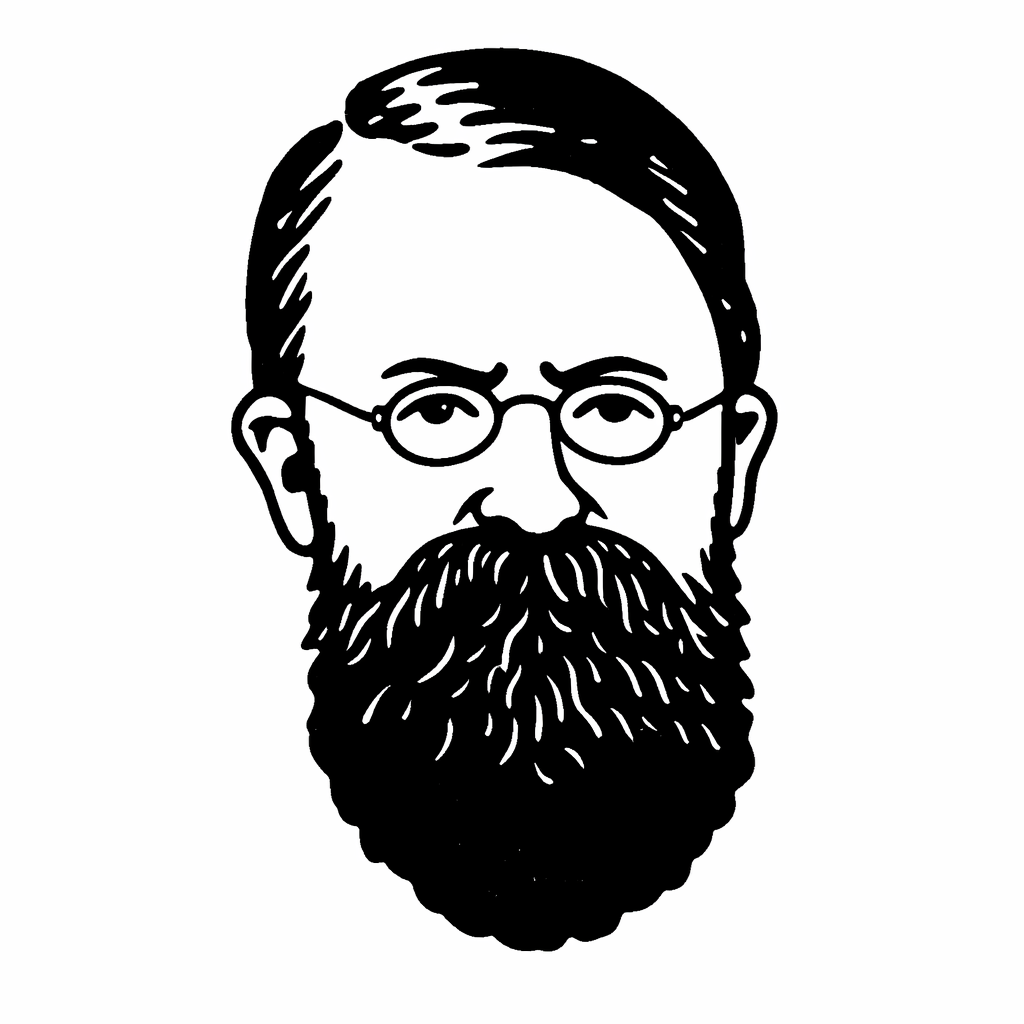
The background
- Nationality:
- Austrian
- Schools:
- Logical positivism, American pragmatism, Empirio-criticism, Phenomenalism, Positivism, Constructivism
- Branchs:
- Physics, Philosophy of science, Psychology, Physiology, Fluid mechanics, Optics, Acoustics, Cosmology, Sensory perception
- Period:
- 19th century
The synopsis
Ernst Waldfried Josef Wenzel Mach (18 February 1838 – 19 February 1916) was an Austrian physicist and philosopher who contributed to the understanding of the physics of shock waves. The ratio of the speed of a flow or object to that of sound is named the Mach number in his honor. As a philosopher of science, he was a major influence on logical positivism and American pragmatism. Through his criticism of Isaac Newton's theories of space and time, he foreshadowed Albert Einstein's theory of relativity.
Mach was born in Chrlice, Moravia, Austrian Empire. His father was a tutor, and Mach was educated at home until age 14, after which he attended a gymnasium. He studied physics and medical physiology at the University of Vienna, earning a doctorate in physics in 1860. His early work focused on the Doppler effect. He held professorships in mathematics and physics at the University of Graz and later in physics at Charles-Ferdinand University in Prague, where he stayed for 28 years before returning to Vienna. His research included descriptions and photographs of shock waves, contributions to psychology and physiology (including the Mach bands illusion and the function of semicircular canals), and the Mach principle regarding inertia.
As a philosopher, Mach defended phenomenalism, asserting that only sensations are real. This influenced his opposition to atomic theory. He critically engaged with the scientific establishment, advocating for an economical and simple expression of facts in scientific laws. His philosophy of empirio-criticism significantly impacted logical positivism and inspired debates, notably with Lenin's critique in 'Materialism and Empirio-criticism.' Mach also contributed to the idea of constructivism and influenced fields like Gestalt psychology. He died in Vaterstetten, Bavaria, in 1916.
The works
Über elektrische Ladungen und Induktion
Optisch-akustische Versuche
Beiträge zur Analyse der Empfindungen
Photographische Fixirung der durch Projectile in der Luft eingeleiteten Vorgänge
Principien der Wärmelehre
Die Mechanik in ihrer Entwicklung historisch-kritisch dargestellt
Erkenntnis und Irrtum: Skizzen zur Psychologie der Forschung
The Science of Mechanics
Contributions to the Analysis of Sensation
Popular Scientific Lectures
Space and Geometry from the Point of View of Physical Inquiry
History and Root of the Principle of the Conservation of Energy
The Principles of Physical Optics
Knowledge and Error
Principles of the Theory of Heat
Fundamentals of the Theory of Movement Perception
The quotes
The fact is, every thinker, every philosopher, the moment he is forced to abandon his one-sided intellectual occupation by practical necessity, immediately returns to the general point of view of mankind.
Personally, people know themselves very poorly.
The biological task of science is to provide the fully developed human individual with as perfect a means of orientating himself as possible. No other scientific ideal can be realised, and any other must be meaningless.
If our dreams were more regular, more connected, more stable, they would also have more practical importance for us.
Ordinarily pleasure and pain are regarded as different from sensations.
The ego is as little absolutely permanent as are bodies.
A movement that we will to execute is never more than a represented movement, and appears in a different domain from that of the executed movement, which always takes place when the image is vivid enough.
The task which we have set ourselves is simply to show why and for what purpose we hold that standpoint during most of our lives, and why and for what purpose we are provisionally obliged to abandon it.
When I recall today my early youth, I should take the boy that I then was, with the exception of a few individual features, for a different person, were it not for the existence of the chain of memories.
My table is now brightly, now dimly lighted. Its temperature varies. It may receive an ink stain. One of its legs may be broken. It may be repaired, polished, and replaced part by part. But, for me, it remains the table at which I daily write.
Physics is experience, arranged in economical order.
Similarly, many a young man, hearing for the first time of the refraction of stellar light, has thought that doubt was cast on the whole of astronomy, whereas nothing is required but an easily effected and unimportant correction to put everything right again.
Man is pre-eminently endowed with the power of voluntarily and consciously determining his own point of view.
Science always has its origin in the adaptation of thought to some definite field of experience.
The plain man is familiar with blindness and deafness, and knows from his everyday experience that the look of things is influenced by his senses; but it never occurs to him to regard the whole world as the creation of his senses.
A colour is a physical object as soon as we consider its dependence, for instance, upon its luminous source, upon other colours, upon temperatures, upon spaces, and so forth.
Thing, body, matter, are nothing apart from the combinations of the elements, - the colours, sounds, and so forth - nothing apart from their so-called attributes.
Many an article that I myself penned twenty years ago impresses me now as something quite foreign to myself.
Bodies do not produce sensations, but complexes of elements (complexes of sensations) make up bodies.