The Philosopher
David Brewster
The face
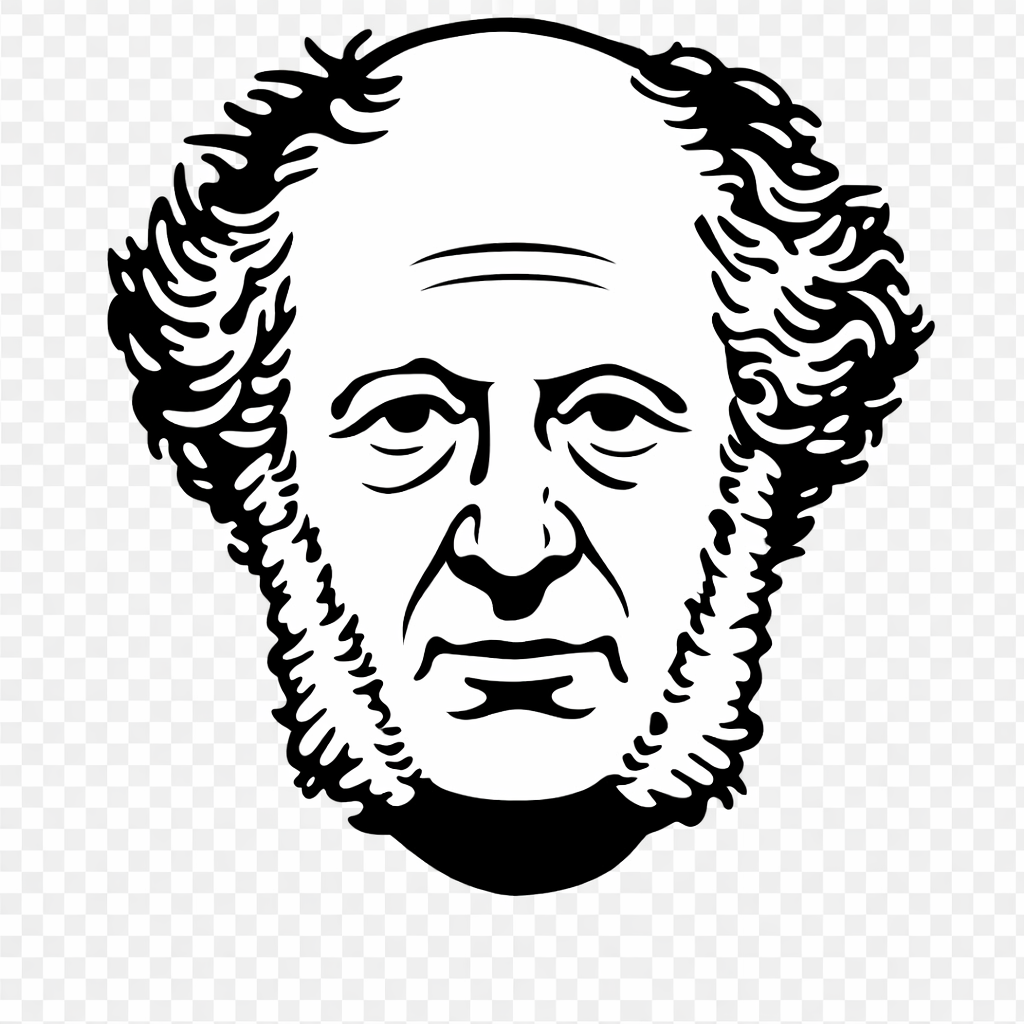
The background
- Nationality:
- Scottish
- Branchs:
- Physical optics, Polarization of light, Birefringence, Photoelasticity, Optical mineralogy, Photography, History of Science, Astronomy, Mathematics, Physics
- Period:
- 19th century
The synopsis
Sir David Brewster (11 December 1781 – 10 February 1868) was a Scottish scientist, inventor, author, and academic administrator. In science, he is principally remembered for his experimental work in physical optics, mostly concerned with the study of the polarization of light and including the discovery of Brewster's angle. He studied the birefringence of crystals under compression and discovered photoelasticity, thereby creating the field of optical mineralogy. For this work, William Whewell dubbed him the "father of modern experimental optics" and "the Johannes Kepler of optics."
Brewster was a pioneer in photography. He invented an improved stereoscope, which he called "lenticular stereoscope" and which became the first portable 3D-viewing device. He also invented the stereoscopic camera, two types of polarimeters, the polyzonal lens, the lighthouse illuminator, and the kaleidoscope.
Brewster was a devout Presbyterian and marched arm-in-arm with his brother during the events of the Disruption of 1843, which led to the formation of the Free Church of Scotland. As a historian of science, Brewster focused on the life and work of his hero, Isaac Newton. Brewster published a detailed biography of Newton in 1831 and later became the first scholar to examine many of the papers in Newton's Nachlass (the unpublished documents left after his death). Brewster also wrote numerous works of popular science, and was one of the founders of the British Science Association, of which he was elected president in 1849. He became the public face of higher education in Scotland, serving as Principal of the University of St Andrews (1837–1859) and later of the University of Edinburgh (1859–1868). Brewster also edited the 18-volume Edinburgh Encyclopædia.
The works
Treatise on new philosophical instruments for various purposes in the arts and sciences
Patent for the kaleidoscope
Life of Sir Isaac Newton
Letters on Natural Magic
The Martyrs of Science, or the Lives of Galileo, Tycho Brahe, and Kepler
More Worlds than One
Memoirs of the Life, Writings and Discoveries of Sir Isaac Newton
The History of Free Masonry, Drawn from Authentic Sources of Information; with an Account of the Grand Lodge of Scotland, from Its Institution in 1736, to the Present Time
Review of Vestiges of the Natural History of Creation
The Facts and Fancies of Mr Darwin