The Philosopher
Daniel Dennett
The face
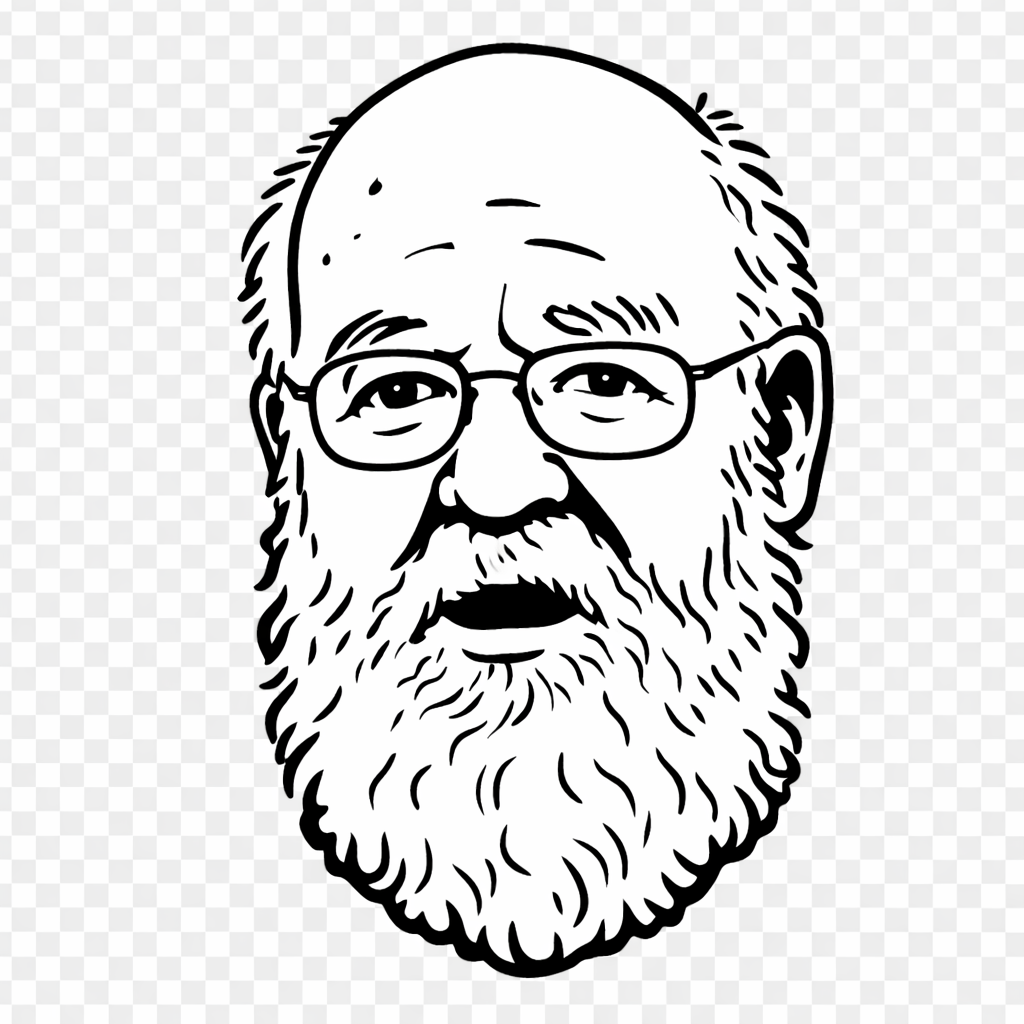
The background
- Nationality:
- American
- Schools:
- Analytic philosophy, New Atheism, Materialism
- Branchs:
- Philosophy of mind, Philosophy of science, Philosophy of biology, Cognitive science, Evolutionary biology
- Period:
- 20th, 21st-century
The synopsis
The works
Brainstorms: Philosophical Essays on Mind and Psychology
The Mind's I: Fantasies And Reflections On Self & Soul
Elbow Room: The Varieties of Free Will Worth Wanting
Content and Consciousness
The Intentional Stance
Consciousness Explained
Darwin's Dangerous Idea: Evolution and the Meanings of Life
Kinds of Minds: Towards an Understanding of Consciousness
Brainchildren: Essays on Designing Minds
Freedom Evolves
Sweet Dreams: Philosophical Obstacles to a Science of Consciousness
Breaking the Spell: Religion as a Natural Phenomenon
Neuroscience and Philosophy: Brain, Mind, and Language
Science and Religion: Are They Compatible?
Intuition Pumps and Other Tools for Thinking
Caught in the Pulpit: Leaving Belief Behind
Inside Jokes: Using Humor to Reverse-Engineer the Mind
From Bacteria to Bach and Back: The Evolution of Minds
I've Been Thinking
The quotes
A child raised on a desert island, alone, without social interaction, without language, and thus lacking empathy, is still a sentient being.
The secret of happiness is: Find something more important than you are and dedicate your life to it.
Human freedom is not an illusion; it is an objective phenomenon, distinct from all other biological conditions and found in only one species - us.
The problem is that no ethical system has ever achieved consensus. Ethical systems are completely unlike mathematics or science. This is a source of concern.
As every scuba diver knows, panic is your worst enemy: when it hits, your mind starts to thrash and you are likely to do something really stupid and self-destructive.
Some cultural phenomena bear a striking resemblance to the cells of cell biology, actively preserving themselves in their social environments, finding the nutrients they need and fending off the causes of their dissolution.
Wherever there is a design that is highly successful in a broad range of similar environments, it is apt to emerge again and again, independently - the phenomenon known in biology as convergent evolution. I call these designs 'good tricks.'
We should get used to the idea that we'll probably never be able to find - and confirm - a good explanation of the ultimate origin of the universe, though I see no reason to believe that we can't press much further on this question than we have managed to date.
Darwin's idea of natural selection makes people uncomfortable because it reverses the direction of tradition.
In 50 years - or 20 years, or 200 years - our current epistemic horizon (the Big Bang, roughly) may look as parochial as the horizon Newton had to settle for in his day, but no doubt there will still be good questions whose answers elude us.
We adore babies because they're so cute. And, of course, we are amused by jokes because they are funny. This is all backwards. It is. And Darwin shows us why.
There is no reality of consciousness independent of the effects of various vehicles of content on subsequent action (and hence, of course, on memory).
The juvenile sea squirt wanders through the sea searching for a suitable rock or hunk of coral to cling to and make its home for life. For this task, it has a rudimentary nervous system. When it finds its spot and takes root, it doesn't need its brain anymore so it eats it!
Words have a genealogy and it's easier to trace the evolution of a single word than the evolution of a language.
Some of the greatest, most revolutionary advances in science have been given their initial expression in attractively modest terms, with no fanfare.
In short, we need to recover the courage we celebrate in our heroes, and in particular, the courage to tolerate, for the sake of a free society, a level of risk we hardly ever imagined in the past.
I don't think the 9/11 attacks taught us anything we didn't already know about religion. It has long been obvious - even to the deeply religious - that religious fanaticism is an extremely dangerous deranger of otherwise sane and goodhearted people.
Now that mobile phones and the internet have altered the epistemic selective landscape in a revolutionary way, every religious organisation must scramble to evolve defences or become extinct.
Natural selection is not gene centrist and nor is biology all about genes; our comprehending minds are a result of our fast evolving culture.
If the history of resistance to Darwinian thinking is a good measure, we can expect that long into the future, long after every triumph of human thought has been matched or surpassed by 'mere machines,' there will still be thinkers who insist that the human mind works in mysterious ways that no science can comprehend.
I think many people are terribly afraid of being demoted by the Darwinian scheme from the role of authors and creators in their own right into being just places where things happen in the universe.