The Philosopher
Charles Darwin
The face
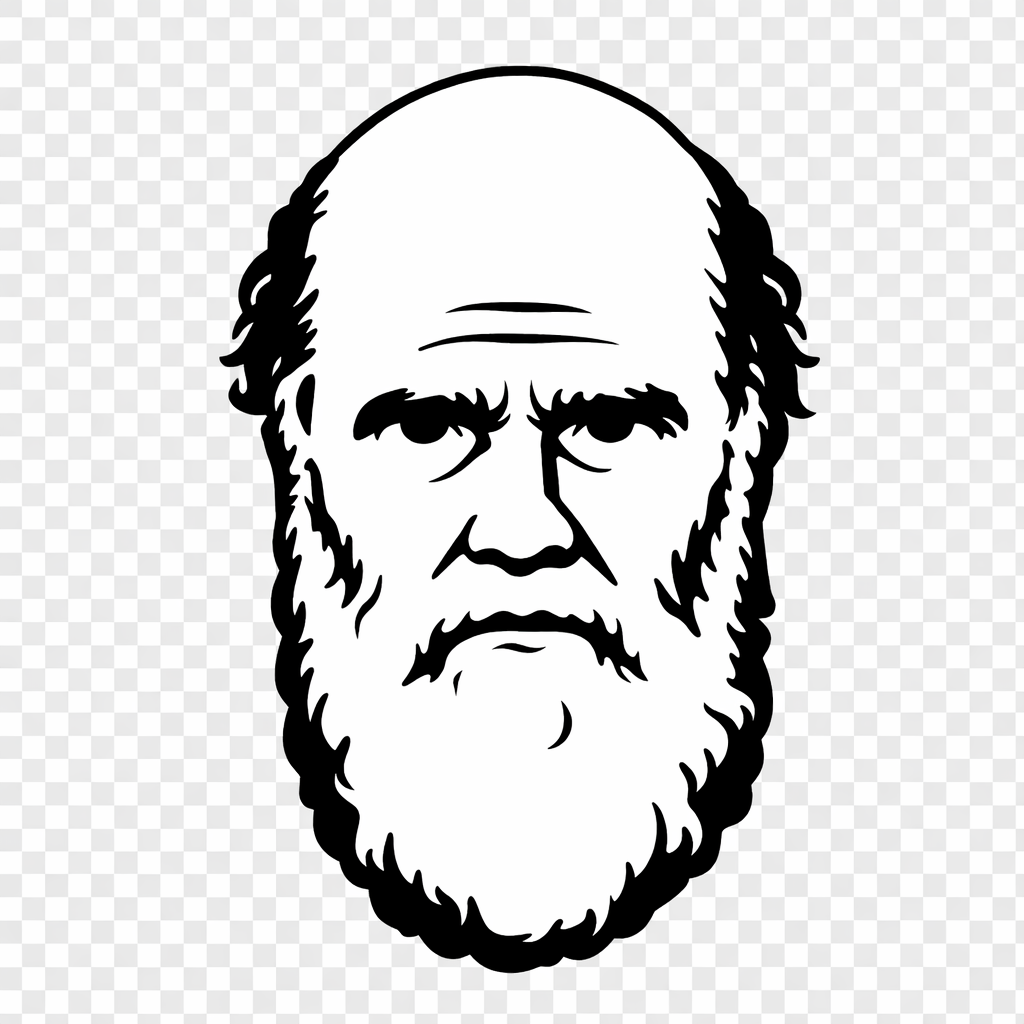
The background
- Nationality:
- English
- Period:
- Victorian era
The synopsis
Charles Robert Darwin (12 February 1809 – 19 April 1882) was an English naturalist, geologist, and biologist, widely known for his contributions to evolutionary biology. His proposition that all species of life have descended from a common ancestor is now generally accepted and considered a fundamental scientific concept. In a joint presentation with Alfred Russel Wallace, he introduced his scientific theory that this branching pattern of evolution resulted from a process he called natural selection, in which the struggle for existence has a similar effect to the artificial selection involved in selective breeding. Darwin has been described as one of the most influential figures in human history and was honoured by burial in Westminster Abbey. Darwin's early interest in nature led him to neglect his medical education at the University of Edinburgh; instead, he helped Robert Edmond Grant to investigate marine invertebrates. His studies at the University of Cambridge's Christ's College from 1828 to 1831 encouraged his passion for natural science. However, it was his five-year voyage on HMS *Beagle* from 1831 to 1836 that truly established Darwin as an eminent geologist. The observations and theories he developed during his voyage supported Charles Lyell's concept of gradual geological change. Publication of his journal of the voyage made Darwin famous as a popular author. His first scientific work was *The Structure and Distribution of Coral Reefs* (1842). Along with his work on barnacles, it won him the Royal Medal in 1853. Puzzled by the geographical distribution of wildlife and fossils he collected on the voyage, Darwin began detailed investigations and, in 1838, devised his theory of natural selection. Although he discussed his ideas with several naturalists, he needed time for extensive research, and his geological work had priority. He was writing up his theory in 1858 when Wallace sent him an essay that described the same idea, prompting the immediate joint submission of both their theories to the Linnean Society of London. Darwin's work established evolutionary descent with modification as the dominant scientific explanation of natural diversification. Darwin published his theory of evolution with compelling evidence in *On the Origin of Species* (1859). He explored coevolution in *Fertilisation of Orchids* (1862) and human evolution and sexual selection in *The Descent of Man, and Selection in Relation to Sex* (1871). *The Expression of the Emotions in Man and Animals* (1872) was an early work of psychology, and one of the first books to feature photographs. His final book was *The Formation of Vegetable Mould, through the Actions of Worms* (1881). By the 1870s, the scientific community and a majority of the educated public had accepted evolution as a fact. However, many initially favoured competing explanations that gave only a minor role to natural selection. It was not until the emergence of the modern evolutionary synthesis from the 1930s to the 1950s that a broad consensus developed in which natural selection was the basic mechanism of evolution. Darwin's discovery is the unifying theory of the life sciences, explaining the unity and diversity of life.
The works
The quotes
An American monkey, after getting drunk on brandy, would never touch it again, and thus is much wiser than most men.
A scientific man ought to have no wishes, no affections, - a mere heart of stone.
I have tried lately to read Shakespeare, and found it so intolerably dull that it nauseated me.
I cannot persuade myself that a beneficent and omnipotent God would have designedly created parasitic wasps with the express intention of their feeding within the living bodies of Caterpillars.
How paramount the future is to the present when one is surrounded by children.
False facts are highly injurious to the progress of science, for they often endure long; but false views, if supported by some evidence, do little harm, for every one takes a salutary pleasure in proving their falseness.
We can allow satellites, planets, suns, universe, nay whole systems of universes, to be governed by laws, but the smallest insect, we wish to be created at once by special act.
I have steadily endeavoured to keep my mind free so as to give up any hypothesis, however much beloved (and I cannot resist forming one on every subject), as soon as facts are shown to be opposed to it.
To kill an error is as good a service as, and sometimes even better than, the establishing of a new truth or fact.
We must, however, acknowledge, as it seems to me, that man with all his noble qualities... still bears in his bodily frame the indelible stamp of his lowly origin.
The mystery of the beginning of all things is insoluble by us; and I for one must be content to remain an agnostic.
The highest possible stage in moral culture is when we recognize that we ought to control our thoughts.
I have called this principle, by which each slight variation, if useful, is preserved, by the term of Natural Selection.
I love fools' experiments. I am always making them.
A man's friendships are one of the best measures of his worth.
Ignorance more frequently begets confidence than does knowledge: it is those who know little, and not those who know much, who so positively assert that this or that problem will never be solved by science.
On the ordinary view of each species having been independently created, we gain no scientific explanation.
A moral being is one who is capable of reflecting on his past actions and their motives - of approving of some and disapproving of others.
What a book a devil's chaplain might write on the clumsy, wasteful, blundering, low, and horribly cruel work of nature!
If the misery of the poor be caused not by the laws of nature, but by our institutions, great is our sin.
Man is descended from a hairy, tailed quadruped, probably arboreal in its habits.
I am turned into a sort of machine for observing facts and grinding out conclusions.
Animals, whom we have made our slaves, we do not like to consider our equal.