The Philosopher
Benjamin Peirce
The face
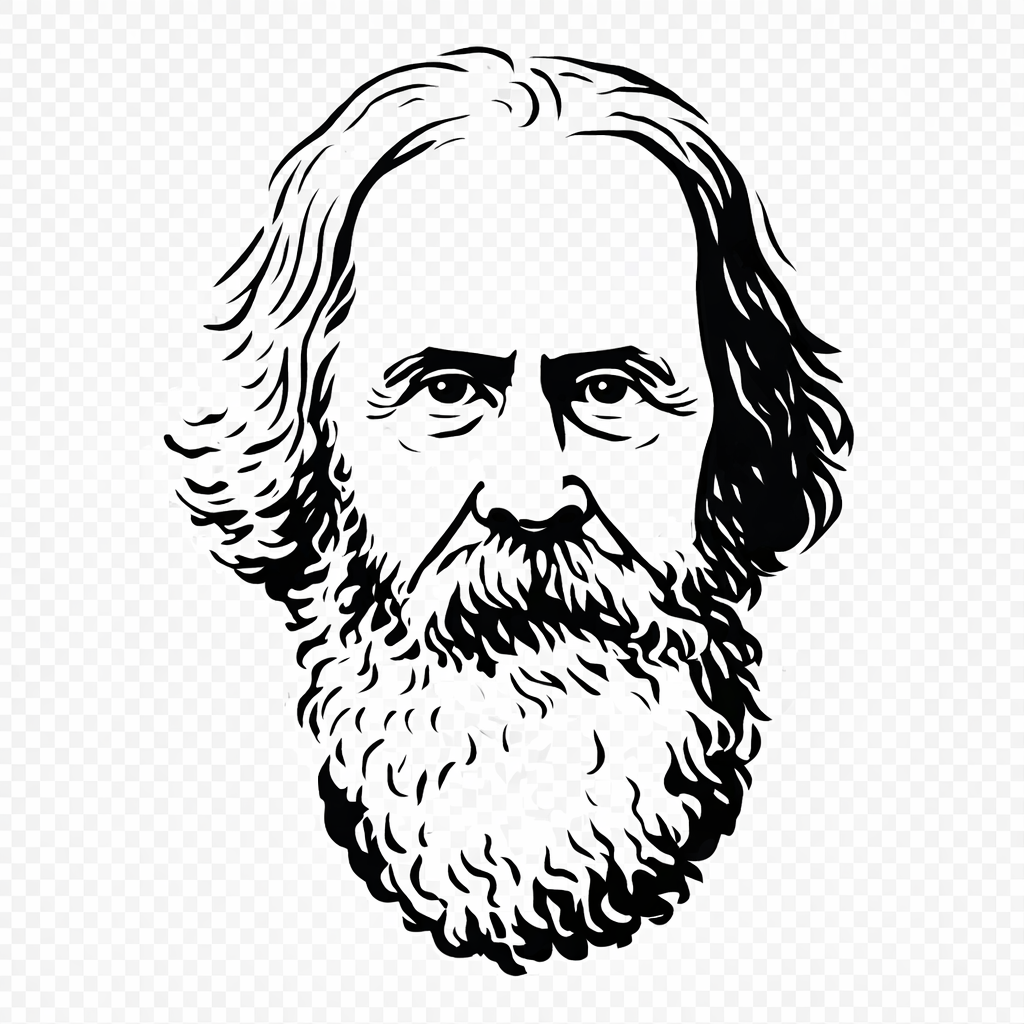
The background
- Nationality:
- American
- Schools:
- Pragmatism
- Branchs:
- Mathematics, Statistics, Number Theory, Algebra, Celestial mechanics, Philosophy of mathematics, Science policy, Astronomy
- Period:
- 19th-century
The synopsis
Benjamin Peirce was an American mathematician and philosopher of mathematics. He taught at Harvard University for approximately 50 years, making significant contributions to celestial mechanics, statistics, number theory, and algebra. He is recognized for his work on associative algebras, introducing terms like 'idempotent' and 'nilpotent'. Peirce also proposed 'Peirce's Criterion' for identifying outliers in statistical data. In the philosophy of mathematics, he famously stated that "Mathematics is the science that draws necessary conclusions." His ideas influenced his son, Charles Sanders Peirce, a prominent logician and philosopher. Peirce also served as the director of the United States Coast Survey and was a charter member of the National Academy of Sciences.
The works
An Elementary Treatise on Plane and Spherical Trigonometry
Physical and Celestial Mechanics
Linear Associative Algebra
A System of Analytical Mechanics