The Philosopher
Alhazen
The face
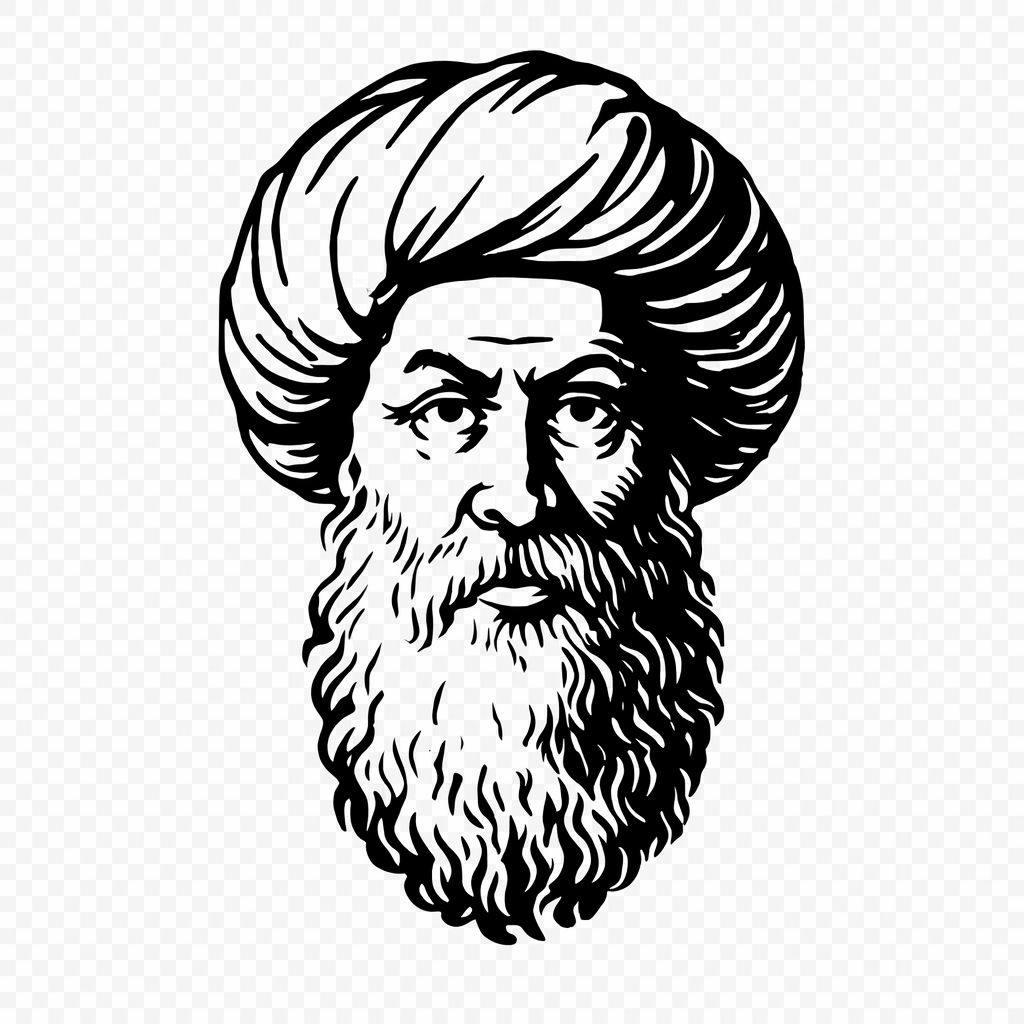
The background
- Nationality:
- Arab
- Schools:
- Aristotelianism
- Branchs:
- Optics, Visual perception, Catoptrics, Dioptrics, Physics, Mathematics, Astronomy, Philosophy, Theology, Medicine, Engineering
- Period:
- Islamic Golden Age
The synopsis
Ibn al-Haytham (Latinized as Alhazen) was a mathematician, astronomer, and physicist of the Islamic Golden Age from present-day Iraq. Referred to as "the father of modern optics", he made significant contributions to the principles of optics and visual perception in particular. His most influential work is titled Kitāb al-Manāẓir (Arabic: كتاب المناظر, 'Book of Optics'), written during 1011–1021, which survived in a Latin edition. The works of Alhazen were frequently cited during the Scientific Revolution by Galileo Galilei, René Descartes, Johannes Kepler, and Christiaan Huygens.
Ibn al-Haytham was the first to correctly prove vision as intromissive rather than extramissive, and to argue that vision occurs in the brain, pointing to observations that it is subjective and affected by personal experience. He also stated the principle of least time for refraction which would later become Fermat's principle. He made major contributions to catoptrics and dioptrics by studying reflection, refraction and nature of images formed by light rays. He was the first physicist to give complete statement of the law of reflection. Ibn al-Haytham was an early proponent of the concept that a hypothesis must be supported by experiments based on confirmable procedures or mathematical reasoning – an early pioneer in the scientific method five centuries before Renaissance scientists, he is sometimes described as the world's "first true scientist". He was also a polymath, writing on philosophy, theology and medicine.
Born in Basra, he spent most of his productive period in the Fatimid capital of Cairo and earned his living authoring various treatises and tutoring members of the nobilities. Ibn al-Haytham is sometimes given the byname al-Baṣrī after his birthplace, or al-Miṣrī ('the Egyptian'). Al-Haytham was dubbed the "Second Ptolemy" by Abu'l-Hasan Bayhaqi and "The Physicist" by John Peckham. Ibn al-Haytham paved the way for the modern science of physical optics.
The works
Book of Optics
Doubts Concerning Ptolemy
On the Configuration of the World
Model of the Motions of Each of the Seven Planets
Treatise on Light
Treatise on Place
Treatise on the Influence of Melodies on the Souls of Animals
A book in engineering analysis
The whole in the assets of the account
Say in the sphere
Saying the unknown in the calculation of transactions
Triangle properties from the side of the column
A message in the free space
Explain the origins of Euclid
The burning mirrors of the rainbow
Treatise on Centers of Gravity