The Philosopher
Alfred Russel Wallace
The face
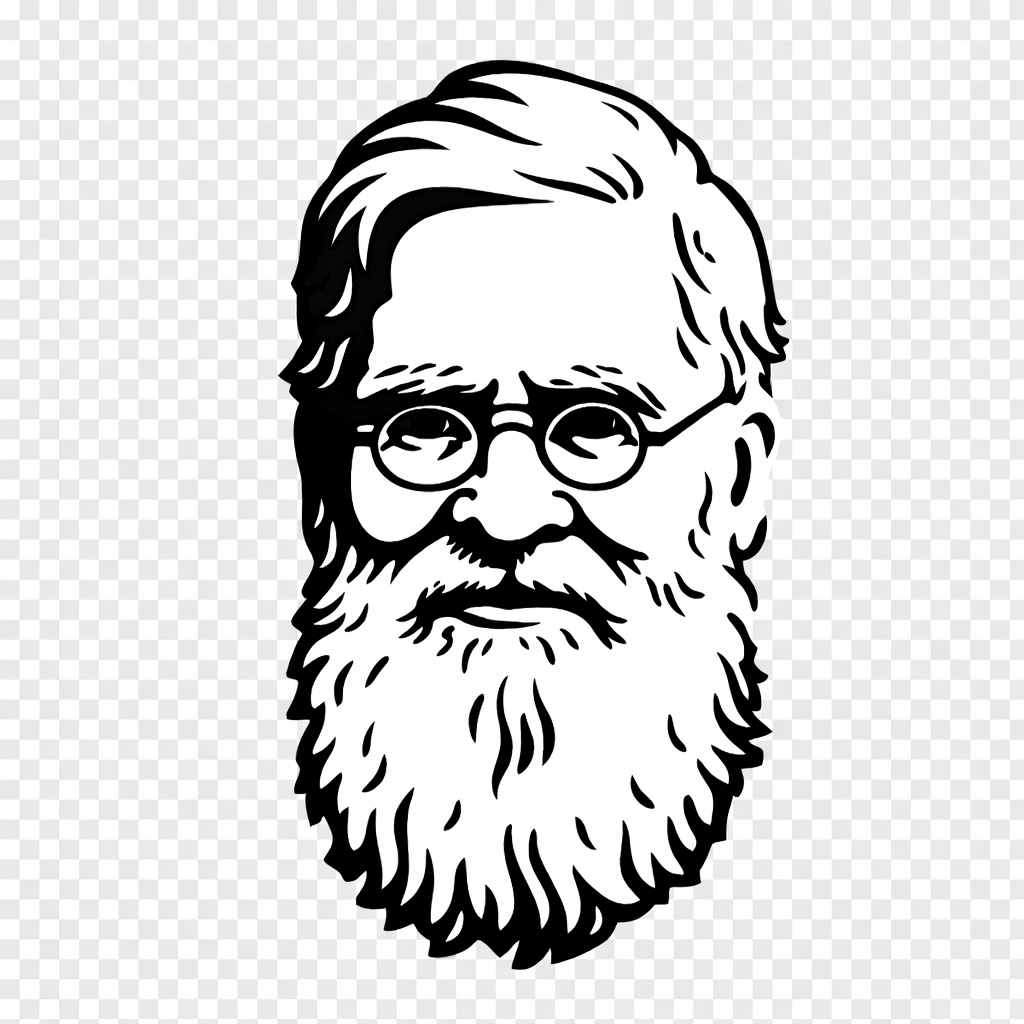
The background
- Nationality:
- English
- Branchs:
- Evolutionary biology, Biogeography, Ecology, Zoology, Anthropology, Astrobiology
- Period:
- 19th-century
The synopsis
Alfred Russel Wallace (8 January 1823 – 7 November 1913) was an English naturalist, explorer, geographer, anthropologist, biologist, and illustrator. He independently conceived the theory of evolution through natural selection; his 1858 paper on the subject was published that year alongside extracts from Charles Darwin's writings on the topic. It spurred Darwin to set aside the "big species book" he was drafting and to quickly write an abstract of it, which was published in 1859 as *On the Origin of Species*. Wallace did extensive fieldwork, starting in the Amazon River basin. He then did fieldwork in the Malay Archipelago, where he identified the faunal divide now termed the Wallace Line, which separates the Indonesian archipelago into two distinct parts: a western portion in which the animals are largely of Asian origin, and an eastern portion where the fauna reflect Australasia. He was considered the 19th century's leading expert on the geographical distribution of animal species, and is sometimes called the "father of biogeography", or more specifically of zoogeography. Wallace was one of the leading evolutionary thinkers of the 19th century, working on warning coloration in animals and reinforcement (sometimes known as the Wallace effect), a way that natural selection could contribute to speciation by encouraging the development of barriers against hybridisation. In 1864 he was the first to propose that during the later stages of human evolution natural selection would have primarily acted on mental facualties rather than on the physical form. Wallace's 1904 book *Man's Place in the Universe* was the first serious attempt by a biologist to evaluate the likelihood of life on other planets. He was one of the first scientists to write a serious exploration of whether there was life on Mars. Aside from scientific work, he was a social activist, critical of what he considered to be an unjust social and economic system in 19th-century Britain. His advocacy of spiritualism and his belief in a non-material origin for the higher mental faculties of humans strained his relationship with other scientists. He was one of the first prominent scientists to raise concerns over the environmental impact of human activity. He wrote prolifically on both scientific and social issues; his account of his adventures and observations during his explorations in Southeast Asia, *The Malay Archipelago*, was first published in 1869. It continues to be both popular and highly regarded.
The works
On the Tendency of Species to Form Varieties; and on the Perpetuation of Varieties and Species by Natural Means of Selection
The Malay Archipelago
Man's Place in the Universe
Is Mars Habitable?
Land Nationalisation; Its Necessity and Its Aims
The Wonderful Century: Its Successes and Its Failures
The Revolt of Democracy
Island Life
Darwinism
On Miracles and Modern Spiritualism
The World of Life
The quotes
I am thankful I can see much to admire in all religions.
To expect the world to receive a new truth, or even an old truth, without challenging it, is to look for one of those miracles which do not occur.
In all works on Natural History, we constantly find details of the marvellous adaptation of animals to their food, their habits, and the localities in which they are found.
To say that mind is a product or function of protoplasm, or of its molecular changes, is to use words to which we can attach no clear conception.
I hold with Henry George, that at the back of every great social evil will be found a great political wrong.
I have since wandered among men of many races and many religions.
I am decidedly of the opinion that in very many instances we can trace such a necessary connexion, especially among birds, and often with more complete success than in the case which I have here attempted to explain.
The foregoing considerations lead us to the very important conclusion, that matter is essentially force, and nothing but force; that matter, as popularly understood, does not exist, and is, in fact, philosophically inconceivable.
What we need are not prohibitory marriage laws, but a reformed society, an educated public opinion which will teach individual duty in these matters.
Civilisation has ever accompanied emigration and conquest - the conflict of opinion, of religion, or of race.
On the spiritual theory, man consists essentially of a spiritual nature or mind intimately associated with a spiritual body or soul, both of which are developed in and by means of a material organism.
It has been generally the custom of writers on natural history to take the habits and instincts of animals as the fixed point, and to consider their structure and organization as specially adapted to be in accordance with them.
What birds can have their bills more peculiarly formed than the ibis, the spoonbill, and the heron?
If this is not done, future ages will certainly look back upon us as a people so immersed in the pursuit of wealth as to be blind to higher considerations.
I spent, as you know, a year and a half in a clergyman's family and heard almost every Tuesday the very best, most earnest and most impressive preacher it has ever been my fortune to meet with, but it produced no effect whatever on my mind.
But naturalists are now beginning to look beyond this, and to see that there must be some other principle regulating the infinitely varied forms of animal life.
To the mass of mankind religion of some kind is a necessity.
Truth is born into this world only with pangs and tribulations, and every fresh truth is received unwillingly.
There is, I conceive, no contradiction in believing that mind is at once the cause of matter and of the development of individualised human minds through the agency of matter.
As well might it be said that, because we are ignorant of the laws by which metals are produced and trees developed, we cannot know anything of the origin of steamships and railways.
Modification of form is admitted to be a matter of time.
In my solitude I have pondered much on the incomprehensible subjects of space, eternity, life and death.