The Philosopher
Alexander Herzen
The face
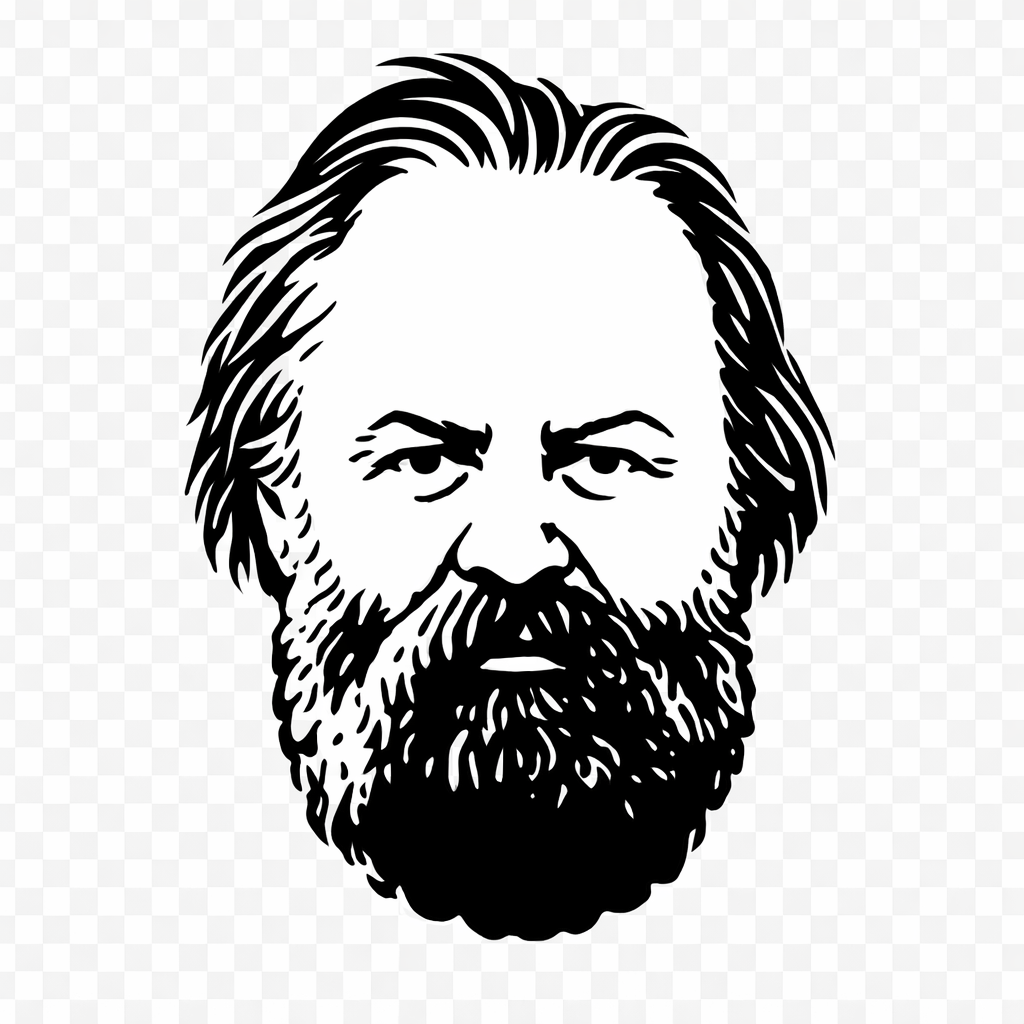
The background
- Nationality:
- Russian
- Schools:
- Westernizers, Agrarian populism
- Branchs:
- Politics, Economics, Class struggle
- Period:
- 19th-century philosophy
The synopsis
Alexander Ivanovich Herzen (1812–1870) was a Russian writer, revolutionary, and precursor to Russian socialism and agrarian populism. Born an illegitimate son in Moscow, he studied at Moscow University. Herzen's early radicalism led to his banishment to Vyatka in 1835, later being transferred to Vladimir. He married Natalya Zakharina in 1837. In 1847, he emigrated with his family and settled in London after a period in Paris and Switzerland, supporting the revolutions of 1848 but becoming disillusioned with European socialist movements. He founded the Free Russian Press in London in 1853, publishing influential newsletters like 'Kolokol' ('Bell') that aimed to influence the situation in Russia, particularly regarding the emancipation of the serfs in 1861. Herzen's personal life was marked by tragedy, including the death of his mother and son in a shipwreck and the death of his wife from tuberculosis. He later had a relationship with Natalia Tuchkova, the wife of his friend Nikolay Ogarev, with whom he had three children. Herzen was involved with the International Workingmen's Association and interacted with figures like Karl Marx and Mikhail Bakunin. He returned to Geneva in 1864 and later died in Paris in 1870. His writings, including the social novel 'Who is to Blame?' and his autobiography 'My Past and Thoughts,' are considered cornerstones of Russian literature and political thought.
The works
Dilettantism in Science
Letters on the Study of Nature
Who is to Blame?
Prervannye Rasskazy (Interrupted Tales)
From the Other Shore
Lettres de France et d'Italie
Du Developpement des idées revolutionnaires en Russie
Memoirs
My Exile to Siberia
My Past and Thoughts
Legend
Elena
Notes of a Young Man
Diletantism in Science
Mimoezdom
Dr. Krupov
Thieving Magpie (novel)
The Russian People and Socialism
Letters from France and Italy
Selected Philosophical Works
My Past and Thoughts: The Memoirs of Alexander Herzen
The quotes
We have wasted our spirit in the regions of the abstract and general just as the monks let it wither in the world of prayer and contemplation.
Science, which cuts its way through the muddy pond of daily life without mingling with it, casts its wealth to right and left, but the puny boatmen do not know how to fish for it.
All religions have based morality on obedience, that is to say, on voluntary slavery. That is why they have always been more pernicious than any political organization. For the latter makes use of violence, the former - of the corruption of the will.
Would it be possible to stand still on one spot more majestically - while simulating a triumphant march forward - than it is done by the two English Houses of Parliament?
Unaware of the absurdity of it, we introduce our own petty household rules into the economy of the universe for which the life of generations, peoples, of entire planets, has no importance in relation to the general development.
Slavery is the first step towards civilization. In order to develop it is necessary that things should be much better for some and much worse for others, then those who are better off can develop at the expense of others.
Modern Western thought will pass into history and be incorporated in it, will have its influence and its place, just as our body will pass into the composition of grass, of sheep, of cutlets, and of men.
You can no more bridle passions with logic than you can justify them in the law courts. Passions are facts and not dogmas.
There is nothing in the world more stubborn than a corpse: you can hit it, you can knock it to pieces, but you cannot convince it.
I am truly horrified by modern man. Such absence of feeling, such narrowness of outlook, such lack of passion and information, such feebleness of thought.
It is possible to lead astray an entire generation, to strike it blind, to drive it insane, to direct it towards a false goal. Napoleon proved this.
Everything in Italy that is particularly elegant and grand borders upon insanity and absurdity or at least is reminiscent of childhood.
What breadth, what beauty and power of human nature and development there must be in a woman to get over all the palisades, all the fences, within which she is held captive!
Life has taught me to think, but thinking has not taught me to live.
Liberalism, austere in political trifles, has learned ever more artfully to unite a constant protest against the government with a constant submission to it.
No one is to blame. It is neither their fault nor ours. It is the misfortune of being born when a whole world is dying.
If nations always moved from one set of furnished rooms to another - and always into a better set - things might be easier, but the trouble is that there is no one to prepare the new rooms. The future is worse than the ocean - there is nothing there.