The Philosopher
Aleksandr Solzhenitsyn
The face
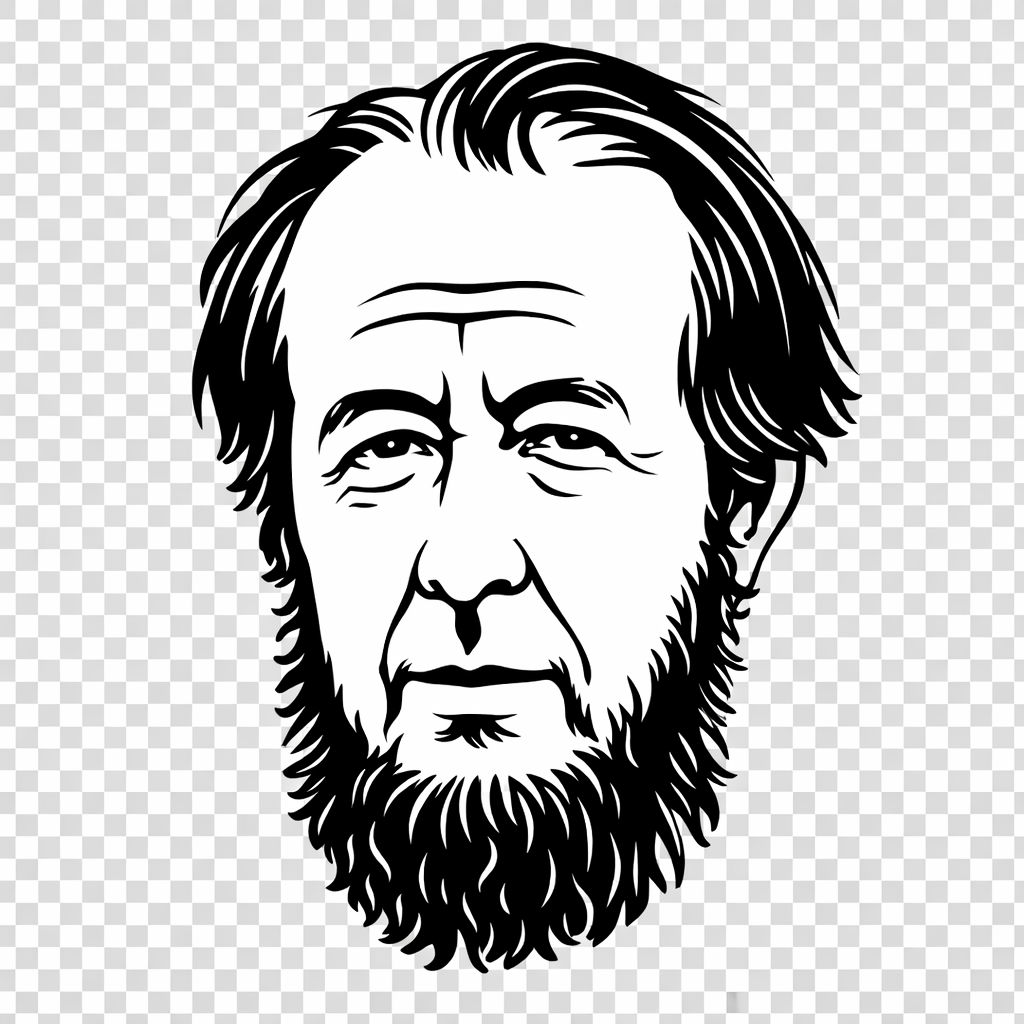
The background
- Nationality:
- Soviet Union, Stateless, Russia
- Schools:
- Rostov State University
- Branchs:
- Russian literature, Soviet dissidents
- Period:
- 20th century
The synopsis
Aleksandr Isayevich Solzhenitsyn was a Soviet and Russian author and dissident who helped raise global awareness of political repression in the Soviet Union, especially the Gulag prison system. Awarded the 1970 Nobel Prize in Literature, his nonfiction work "The Gulag Archipelago" amounted to a head-on challenge to the Soviet state. Born in Kislovodsk, his father died shortly after his birth. Raised by his mother, he initially embraced Marxism-Leninism. During World War II, he served as an artillery officer but was arrested for criticizing Joseph Stalin in private correspondence, leading to an eight-year sentence in the Gulag and internal exile. His experiences transformed him into an Eastern Orthodox Christian. Released and exonerated during the Khrushchev Thaw, he began writing novels about his experiences. His first novel, "One Day in the Life of Ivan Denisovich," was published in 1962 with approval from Nikita Khrushchev. After Khrushchev's fall, his works were suppressed, and in 1974, he was stripped of his Soviet citizenship and expelled to West Germany. He lived in Switzerland and then Vermont, USA, before returning to Russia in 1994, where he lived until his death in 2008. Solzhenitsyn was a strong critic of communism and Western materialism, advocating for traditional Russian values and Orthodoxy.
The works
One Day in the Life of Ivan Denisovich
The Gulag Archipelago
Cancer Ward
In the First Circle
August 1914
The quotes
The battleline between good and evil runs through the heart of every man.
The clock of communism has stopped striking. But its concrete building has not yet come crashing down. For that reason, instead of freeing ourselves, we must try to save ourselves from being crushed by its rubble.
Of course God is endlessly multi-dimensional so every religion that exists on earth represents some face, some side of God.
In our country the lie has become not just a moral category but a pillar of the State.
How can you expect a man who's warm to understand one who's cold?
Religion always remains higher than everyday life. In order to make the elevation towards religion easier for people, religion must be able to alter its forms in relation to the consciousness of modern man.
For a country to have a great writer is like having a second government. That is why no regime has ever loved great writers, only minor ones.
Our government declared that it is conducting some kind of great reforms. In reality, no real reforms were begun and no one at any point has declared a coherent programme.
I have spent all my life under a Communist regime, and I will tell you that a society without any objective legal scale is a terrible one indeed. But a society with no other scale but the legal one is not quite worthy of man either.
Talent is always conscious of its own abundance, and does not object to sharing.
It would have been difficult to design a path out of communism worse than the one that has been followed.
If one is forever cautious, can one remain a human being?
The sole substitute for an experience which we have not ourselves lived through is art and literature.
We have arrived at an intellectual chaos.
Human beings yield in many situations, even important and spiritual and central ones, as long as it prolongs one's well-being.
Everything you add to the truth subtracts from the truth.
A man is happy so long as he chooses to be happy and nothing can stop him.
Today when we say the West we are already referring to the West and to Russia. We could use the word 'modernity' if we exclude Africa, and the Islamic world, and partially China.
For us in Russia, communism is a dead dog, while, for many people in the West, it is still a living lion.
The next war... may well bury Western civilization forever.
Violence can only be concealed by a lie, and the lie can only be maintained by violence.
Man has set for himself the goal of conquering the world but in the processes loses his soul.
A state of war only serves as an excuse for domestic tyranny.
You only have power over people so long as you don't take everything away from them. But when you've robbed a man of everything, he's no longer in your power - he's free again.
Literature transmits incontrovertible condensed experience... from generation to generation. In this way literature becomes the living memory of a nation.
It is time in the West to defend not so much human rights as human obligations.
Blow the dust off the clock. Your watches are behind the times. Throw open the heavy curtains which are so dear to you - you do not even suspect that the day has already dawned outside.
When truth is discovered by someone else, it loses something of its attractiveness.
The salvation of mankind lies only in making everything the concern of all.
First would be the literary side, then the spiritual and philosophical. The political side is required principally because of the necessity of the current Russian position.
For us in Russia communism is a dead dog. For many people in the West, it is still a living lion.
The name of 'reform' simply covers what is latently a process of the theft of the national heritage.
There are a lot of clear thinkers everywhere.
Literature becomes the living memory of a nation.
Own only what you can always carry with you: know languages, know countries, know people. Let your memory be your travel bag.
It is the artist who realizes that there is a supreme force above him and works gladly away as a small apprentice under God's heaven.
Hastiness and superficiality are the psychic diseases of the 20th century, and more than anywhere else this disease is reflected in the press.
It is not because the truth is too difficult to see that we make mistakes... we make mistakes because the easiest and most comfortable course for us is to seek insight where it accords with our emotions - especially selfish ones.
Any man who has once proclaimed violence as his method is inevitably forced to take the lie as his principle.
Anyone who has proclaimed violence his method inexorably must choose lying as his principle.
Woe to that nation whose literature is cut short by the intrusion of force. This is not merely interference with freedom of the press but the sealing up of a nation's heart, the excision of its memory.
I can say without affectation that I belong to the Russian convict world no less than I do to Russian literature. I got my education there, and it will last forever.